Yehonatan Abelson—known as “Ioni”—is a managing partner at Bia Consulting. He is Argentine, and for his age, he has extensive experience working on election campaigns and with governments in many countries across the continent. He also studied in the United States and worked there as well. That’s why we chose him to discuss what’s at stake in these elections. He was part of the master’s program at George Washington University, which is the first institution in the region to focus on education in political communication.
I see you recently returned from the United States. How do you view the process? What do you think is at stake? Beyond the current situation, what is at stake in the U.S. election?
The first thing to remember is that the United States is a very federal country, where many of the issues that we here rely on the national government to resolve are actually handled at the state level. So, the presidential campaign has a different meaning there. What, specifically, does a president oversee in the United States?
First, foreign policy, to a large extent—which is why Russia, Ukraine, Israel, and Gaza are such prominent issues in the campaign and such important subjects in the debate.
On the other hand, there are economic issues. The United States is experiencing historically high inflation that is eroding Americans’ wages, which explains Trump’s strong performance, because this inflation is seen as the result of Biden’s post-pandemic economic policies, implemented in an attempt to revive the U.S. economy. This led to massive spending—both on infrastructure and on subsidies to encourage people to spend and boost consumption—which resulted in historically low unemployment but very high inflation. In Argentina, we know exactly what this is all about. Basically, that, combined with the issue of health insurance—healthcare—is another topic that Obama, Biden, and Kamala Harris are very interested in addressing in depth, whereas Trump is not.
Immigration, meanwhile, is another issue over which U.S. presidents exercise significant authority.
And finally, the issue of the Supreme Court: who will nominate the judges to fill any vacancies, if any arise, on the Supreme Court.
There is a candidate who talks about lowering taxes for the middle class so they can spend more, who seeks a more equitable solution between Israel and Gaza, who is more supportive of Ukraine than of Russia, and who favors a path to legalization for immigrants rather than the kind of persecution seen under Trump. And in terms of healthcare, she proposes a more comprehensive policy that would make health insurance more accessible to a larger number of people than Biden’s proposal.
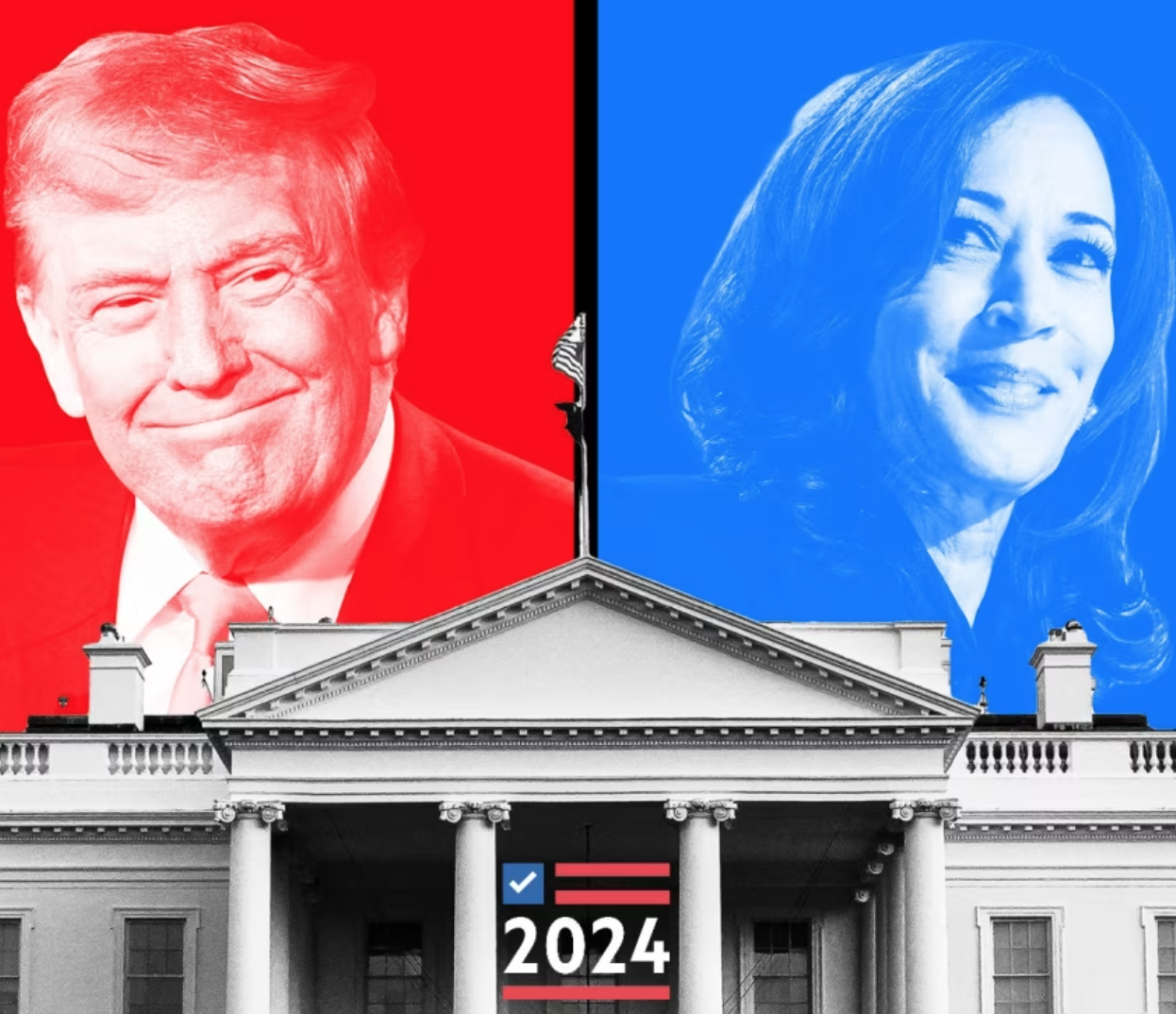
In terms of perception, the contest is politics versus Trump; his main weapon, his main attribute, is being anti-political, being “incorrect,” the issue of the assassination attempts, and operating outside the structure of the Republican Party. Note that he’s not a candidate who says, “I’m going to do away with politics” or “I’m going to go fight Washington.” But he is a candidate who is essentially defined by not being a politician—in contrast to (someone who is) a monument to politics. Both Biden and Harris—although Kamala was a prosecutor and has an interesting background in the legal system—are part of the political establishment. She represents politics less than Biden—much less than Biden—but she does represent it as well.
So, I think that in terms of perception, in terms of the campaign’s messaging, you have that dilemma, that conflict. Anti-politics, if you will—I’ll exaggerate a bit—the far-right versus moderate, center-left, more traditional politics. A situation, a dichotomy that’s playing out in many countries, including our own, and that occurred in our country last year.
So, basically, two historical models are at play. Perhaps this is the election where the left-right divide is clearest, in my view, where on one side you have a candidate (Trump) who proposes cutting taxes for the wealthy—and essentially that’s it—to revive the economy. And, well, he’s pro-Israel—in a much more radical way—and also more pro-Russia. I’m not quite sure how to categorize that; I don’t know if that’s more right-wing or not—I have no idea—but that’s the general direction, and he’s very anti-immigration.
I see. So, you’re very clearly outlining the issues that, in some way, fall under the president’s purview. And also, what each of the candidates stands for. What was the nature of the shift in the Democratic ticket from Biden to Kamala Harris? What do you think she brings to the table?
It was a truly historic move in the sense that it was unprecedented. That is very unusual in a democracy as institutionalized as the American one, where there are two entrenched parties, everything is decided within those parties, and a candidate emerges from that internal nomination process. There has never been a competitive candidate from outside those two parties.
A candidate nominated by a party—the sitting president, who had gone through all the primaries and the entire nomination process—stepped down under pressure from the party and pressure groups within the Democratic Party, making way for his vice president. Again, unheard of. But what did it mean?
Under no circumstances did it signify weakness—which is something that really strikes me—it isn’t seen as a bad thing; in other words, it didn’t detract from the Democrats at all—quite the contrary. But the most interesting thing is that it added two things: change and youth. Today, the “old” candidate is Trump; today, the candidate of continuity is Trump, because Trump was president and Kamala wasn’t president—she was vice president. But anyway, her slogan is, in fact, moving on—“let’s move forward, let’s forget the past,” with Trump cast as that past. So, this move does more than rid you of the burden of a very old candidate—who clearly wasn’t in good enough shape to compete—and, let’s face it, a loser, a candidate who was going to lose.
It gives her two key attributes for campaigning. Now, speaking of the campaign—in terms of the campaign—it gives her two key attributes: youth—now Trump is the “old guy”—and the future—now Trump represents the past. And from there, they can build a much more competitive campaign with a much better chance of victory than the one Biden could have run. I think that’s the key point, and it showed up very quickly in the polls. Right now, they’re neck and neck, with a slight edge for Trump. But we’re talking about modeling—that is, predictions based on models. If you look at the raw poll data, they’re tied.
Sure. And do you think this change in the Democratic ticket might have thrown Trump’s campaign team off balance, disorganized them, or left them unsure of how to respond? At least in the debate between Kamala Harris and Trump, I got the impression that Trump seemed out of sorts, as if he didn’t know how to handle himself. And Kamala Harris knew she had new points of differentiation to capitalize on.
Kamala’s campaign came in with a very clear and effective message and strategy. First, she co-opted the concept of freedom, which I think is excellent. They didn’t go in saying… I thought it was going to be a campaign that would focus much more on a socialist agenda of healthcare for all, gender equality, and all that.
Yes, she is campaigning very strongly on abortion, because the issue is very important in some states that are key to winning the election. They are progressive but closely contested states, which is precisely why they are key.
But, on the other hand, the freedom frame was very powerful. Here, the Democrats are framing the election as a choice between authoritarianism and freedom, which I think is much more brilliant than framing it in terms of right versus left or those issues I mentioned earlier—a more involved government versus a less involved government—which, in the end, are arguments that are much harder for anyone to swallow, but especially for the middle class, which is who you’re theoretically trying to reach. On the other hand, I see Trump as completely lost, and his campaign unable to find its footing. Trump was always very good at coming up with a nickname and a caricature to make the other person look ridiculous—“Sleepy Joe,” as he called Biden.
Trump always comes up with a nickname, but he hasn’t found one for Kamala yet. In other words, he hasn’t done anything yet that really hits the mark on what the problem is. He hasn’t found her weakness yet. And that’s a big deal—I’m impressed by how hard it’s been for them to frame Kamala’s campaign in a negative light. They’re not succeeding, and they’re not even trying. In fact, Trump’s debate performance was a disaster in my view—though I understand that Trump plays a different game, just like Milei, whose performance in the Argentine debate left analysts horrified, while people watched it and said, “He’s just a regular guy, I don’t know what to make of him.” Well, Trump is similar. Trump rambled in all his answers; they’d ask him about a cat, and he’d talk about a zoo—or just anything. However, as I said, if his selling point is that he’s not a politician, that costs him less than you might think.
And regarding possible or effective innovations you’ve seen so far in the campaign—beyond the candidates themselves, but from the perspective of the organization, in terms of how they’re implemented or how they seek to exploit new possibilities—should we pay attention to them?
New technologies—both in segmentation and artificial intelligence—allow you to run a million different campaigns, but that’s something you don’t see. I mean, you’re not going to see that a middle-class guy from rural Wisconsin is going to receive an ad that’s completely different from what an African American woman in the southern part of the state receives. We can’t see it. I’m sure something like that is happening, because you don’t even have to do it yourself anymore. It’s done automatically with artificial intelligence—you can run as many campaigns as the audience segments you can identify. Now, it doesn’t depend on your ability to run those campaigns, but on your ability to segment. For every niche you find, you can run a campaign for it. That’s the most important thing.
The other thing—Harris’s campaign focusing on freedom—strikes me as brilliant. It’s something to keep in mind, and something I really like, too. It bothers me when progressive or left-wing candidates give up on debates they could actually engage in. It’s very common for left-wing candidates to avoid talking about freedom… Why? Who is freer? A person who has 90% of their salary left over after paying what they have to pay, or a person who has 30% left over. Who is freer? So, if the left doesn’t engage in that discussion… the same goes for security issues. The left has always struggled with this. The moderate left—or whatever you want to call them—has always had a hard time engaging in those discussions, and I think that’s a big mistake. I really like that this campaign is stepping up to take on the fight.
Do you think U.S. democracy is more or less democratic than Argentine democracy? Because it could ultimately happen again that the candidate who receives the most votes is not the one elected president.
Yes, technically speaking, it’s less democratic. But what does happen is that there are states that would otherwise be irrelevant in the electoral math, yet they start to carry a lot of weight. So, in that sense, it’s a good system. In the United States, no one campaigns in California because it is already a given that the Democrats will win there and take all the electoral votes. But then why would anyone campaign in Ohio? Well, it’s because this system requires you to go there, shake hands with a farmer who might represent 0.01%—or 1%—of the electoral weight of a California voter. But under the Electoral College system, that voter ends up carrying 10 times more weight than a California voter. Or, well, 1,000 times, because the California voter ultimately has no influence since it’s a historically Democratic state, just as Texas is a historically Republican state. I’d say it’s less democratic, but it has its charm; there are some good things about the system.
For those of us less familiar with it, how does this system—in which some states are much more important than others—work?
Well, here’s the thing. Each state has a certain number of electors in the Electoral College. It turns out that there are states that certain candidates are bound to win, and states that others are bound to win. Since in most states—especially in general elections—the winner takes all, there are states where the race is competitive. Wisconsin, generally speaking, South Carolina, and Virginia are usually like that. Ohio and Nevada depend on the election, but in general, these are states called swing states, which can go either way. And that’s where you have to do the electoral math. If I lose Pennsylvania, I have to win Ohio and Wisconsin. So, you start tallying things up. And then the states where the election is decided are those that allow either candidate to win. After that, it gets a little more complicated. But broadly speaking, that’s it. So, in those states where either candidate can win, that’s where the election is decided.


