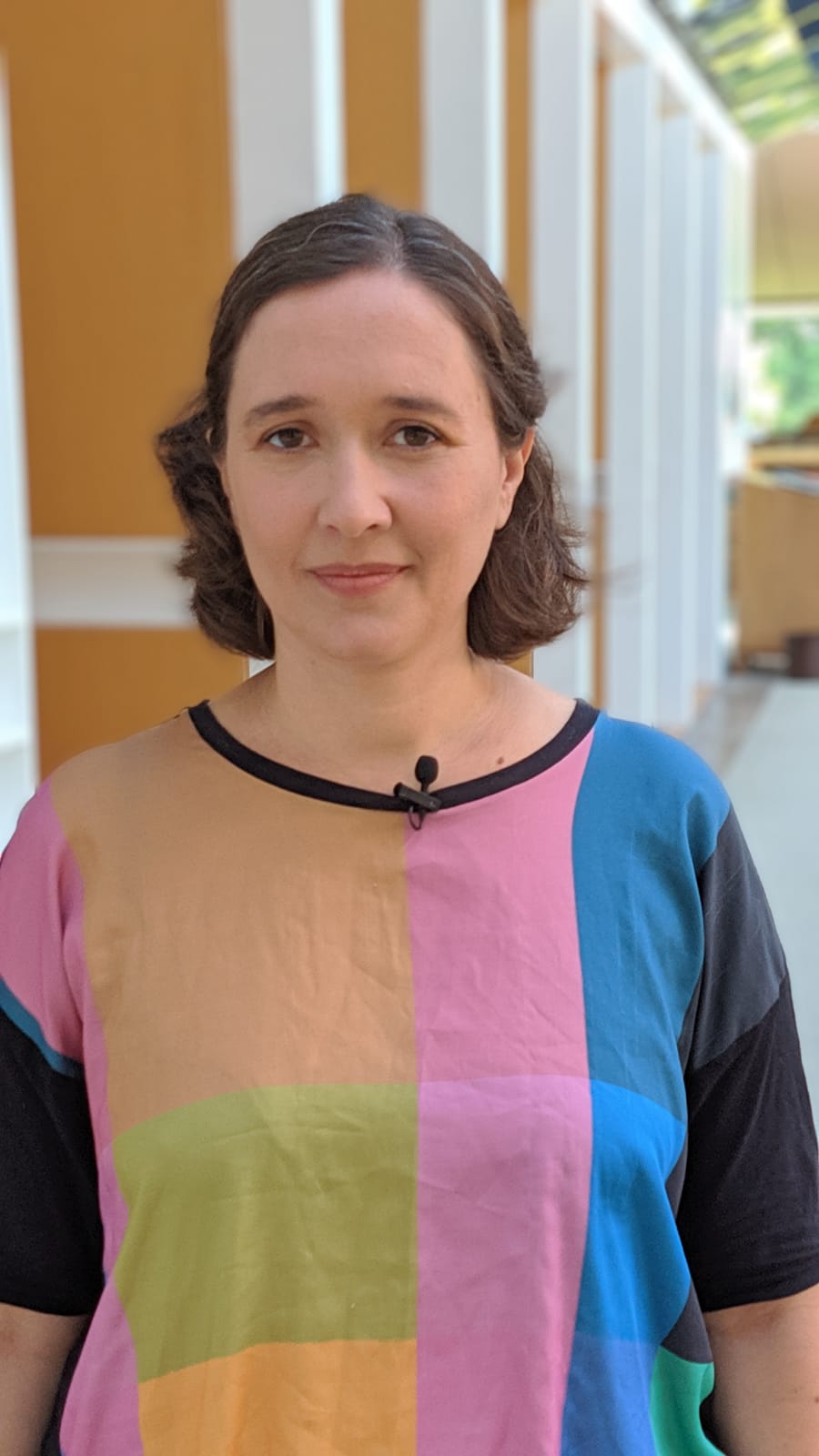
By Lucas Malaspina
Eugenia Mitchelstein is a truly important researcher for us—for those of us interested in communication, politics, and the transformations we are experiencing in this increasingly digitized society.
She holds a bachelor’s degree in political science from the University of Buenos Aires. She then earned a master’s degree from the London School of Economics and Political Science. She also worked as a producer, including for the BBC, before deciding to devote herself to the study of media. She currently directs the Center for Media and Society Studies at the University of San Andrés (UdeSA) and earned her Ph.D. from Northwestern University.
Eugenia, I’d like you to tell us about that personal journey. How did that unfold in your life? How did you first become interested in the topics you’ve been researching for some time now?
I studied political science, but I also studied journalism at TEA, and by the time I was 20 I knew I wanted to work in media. My first job was at a dot-com that went bankrupt in the crash of 2000. Then I started working as a producer on a political journalism show, Majul’s show, La Cornisa. I was working on Majul’s show; I graduated from TEA, was pursuing my degree at the UBA, and won a scholarship for an internship at the BBC, so I went to London. I thought I would work as a producer all my life; I pictured myself as an executive producer. I probably would not have been able to become one, but at 20 that was how I saw myself. I went to London, and there I ran into someone—a friend I knew from television—and asked her, “What are you doing here?” She said, “I’m doing a master’s degree; I won a scholarship.” I said, “Oh! Great.” After living in London for a month, I thought, “I’m coming to live in London for a year.”
So, I graduated—I had three courses left—I took them and applied for the scholarship, and I won it; it was called the Chevening Scholarship. And I went to London for a year to do a master’s degree. And there I thought, “Wow, this is so great—I’m learning so much, and they’re paying me to study.” I came back and wasn’t quite sure what to do with that. Google had just opened an office in Argentina, so I applied for a job there. I had a thousand interviews—I remember—and I felt like I was going to work at NASA, but then I ended up in a job that was very much in marketing and advertising. I’m not a programmer, so I wouldn’t have been able to code anyway. And while I was working at Google, a professor at San Andrés, Hernán Galperín, needed an assistant—someone to teach tutorials. So I started working with him and began teaching classes. I’d never taught before, and I loved it. I told him, “Hey, Hernán, I want to do this—I want to be a professor.” And he told me, “To be a professor, you have to get a Ph.D.” So I went ahead and did it—I applied to four Ph.D. programs, which was totally reckless. People usually apply to 15 Ph.D. programs. I applied to four; that was kind of my limit.
I was accepted into three programs; one turned me down. I spoke with Pablo Boczkowski—co-author of “El entorno digital”—who was teaching at Northwestern, and that’s when I decided to go to Northwestern and start working with him. A Ph.D. program is very much about working with a mentor; you learn a craft. And so, I began to work more seriously—more so than during my master’s program—in academia. I returned and started teaching at San Andrés, and in the meantime, I continued doing research. My work consists partly of teaching—mainly at San Andrés—and partly of research. So that’s how it went.
When I was 18, I didn’t even know that social science research existed. My parents were professionals—my dad was an engineer and my mom was a lawyer—but they didn’t work at the university; they worked in companies. So it was a world I knew nothing about. And I didn’t know that such a thing existed at the university either. It wasn’t until I went to London to do my master’s degree that I said to myself, “I can dedicate myself to this.” And after that, I sort of found my way a little bit.
How do you view your time at the University of Buenos Aires, and how do you feel about the criticism the UBA is receiving from the new government?
My time at the University of Buenos Aires was a very difficult period for the university. As you can see, the university’s budget was very low in the late ’90s and early 2000s. At one point, Menem even tried to cut the budget even further. We organized protests and stopped attending classes for about a month. So it was a time—I mean, compared to students who started in 2007, 2008, and so on—it was a very difficult time for the university. I remember something similar to what I’ve heard is happening now: professors would tell us how much they earned, and we couldn’t believe how little it was. I don’t remember exactly how much it was, given the inflation at the time, but I do remember that the university was in pretty bad shape. And you could see it in the buildings, too. But something I find interesting is that the UBA functioned—and I think it still does today—as a place where you could meet a lot of different people. A lot of different people in terms of ideology, but also in terms of socioeconomic background. And that opened up a whole new world for me—one I didn’t even know existed.
I went to school in the Belgrano neighborhood; I had spent my entire life in Belgrano, and it was the first time I had ventured outside it a little. Another thing I think is great about the UBA—and I assume this is true of other universities, but I’ll speak about the UBA because it’s the one I know—is that when I went off to do my master’s, I had not been an especially brilliant student. My average was eight; it wasn’t as if I had a 10 average, was the best student, and so on. I was working, so I had very little time to study. I remember arriving in London quite worried: “How am I going to do a master’s here with all these people?” Very few people are admitted to the program, and very few win the scholarship. And I did really well—not because, again, I’m especially intelligent, but because the education I had received at the UBA allowed me to be on the same level as the other students. They were among the 10% of applicants admitted to that master’s program, just to give you an idea. So they were all very good. And I was a little worried: English isn’t my native language; it isn’t my mother tongue.
And something I’m really grateful to the UBA for is that ability to say: “I have to study; I have to understand this text.” I’d read the original authors—which doesn’t always happen. Often in undergraduate programs in other countries, students read textbooks, but I had read Durkheim—not the textbook that explains what Durkheim thought. And I thought that was great about the UBA—the kind of education it gave me. I have some criticisms, like everyone else, of the degree program—never mind, the curriculum, which I understand has already changed—but I do appreciate that willingness to say: “Well, I have to understand this subject; I have to sit down and read it; I can do it in English, in Spanish,” and so on. That willingness to take on a challenge, so to speak, is what I value about the UBA. Even under very, very difficult circumstances—as I said, financially—because I studied at the UBA from ’98 to 2003. It was a pretty tough time for the country in general and, obviously, for public universities as well. And I carried that same attitude with me, in a way, when I went on to do my Ph.D.—that willingness to read, understand, and so on.
I remember we had a course called “American Politics,” and no one had read “El federalista” (a collection of essays written between 1787 and 1788 by Alexander Hamilton, James Madison, and John Jay, under the collective pseudonym “Publius,” with the aim of persuading the citizens of New York State to ratify the United States Constitution), and no one had read “La democracia en América” (Alexis de Tocqueville, 1835)—two books that the UBA simply assigned me to read. I was the only one. And everyone else in the class was American. So that’s something I’m grateful for at the UBA.
And another thing that really helped me was that I was working in TV, with very irregular hours—I don’t know, sometimes I wouldn’t work on Wednesdays because the show aired… So, the UBA let me organize my schedule and take classes all day on Wednesdays, Saturday mornings, Thursday nights—you name it.
I must have first read one of your articles—one of those that appeared in Anfibia magazine—in 2016. And I remember that one of the things that caught my attention most is something also explained in “El entorno digital,” which you wrote with Pablo Boczkowski: this idea of “Vivir en las redes.” In other words, it’s not that there is a digital world and a physical or in-person world, but rather that we are immersed in this world, which of course includes the natural and urban environments. We are constantly within the digital world.
WhatsApp is like a corner store, WhatsApp is like a bar, Facebook is like an avenue, Instagram is like a fashion show.
How did you first engage with the digital world on a personal level, and how did you realize this could be a subject of study?
Those are two separate issues. We had a desktop computer at home—I don’t know, a Pentium, I’d say—but I don’t even remember whether it ran Windows. When I was in my fifth year of secondary school, in ’97, we connected it via dial-up. I pestered my parents quite a bit; it wasn’t as if they came home one day and said, “We need to get online.” Not many people were connected, and I thought it was great—I was quite a nerd—that so much information was available. There wasn’t even that much information; we’re talking about the internet in ’97, but it still felt like a lot. I spent a great deal of time late at night, after my family went to sleep, at the computer searching for things and chatting on ICQ, a messaging platform that I don’t think exists anymore. I was fairly adept—I don’t want to say… I wasn’t a tech person and didn’t know how to code, but I more or less managed, and I used the internet quite a bit. I used it for university work and so on. That whole world felt natural and appealing to me.
There’s a quote I really like that goes: “The technologies that exist from the time you’re born until you’re 10 years old, you consider part of the landscape.” In other words: cars, TV, or color TV, in my case. For me, color TV wasn’t a big deal—it was just there in my house. Technologies that come along between the ages of 10 and 30: “How cool—I want more of this; I want to see how it works.” Technologies that come along after age 30 are like, “Ugh, I have to learn how to use this.” Maybe the cutoff isn’t 30 anymore—maybe it’s 40—but there are things I feel increasingly reluctant to deal with. The internet fit that pattern for me: I got into it at 17 or 18, so it was everything; I thought it was great. But I was studying political science and working in TV.
The first time I used the internet for work was during the attack on the Twin Towers. We were all at the station; no one really knew what had happened. There were few people, let’s say, on the production team who could read English, so I started checking the New York Times and Washington Post websites to find out what was going on. It was 2001, so these weren’t the online media sites we know today. And that was the first time I used the internet for work—to try to figure out what had happened, pass on information to the show’s host, and so on. That’s when I saw it as a possibility. I kept working in TV, and until I left the industry in 2004, the ratings would arrive the next day by fax.
I mean, there was internet at the station, there were computers, but the ratings were sent by fax—it was kind of weird. And we had an email address for the show, but nobody checked it; television and the internet were very separate back then. Then I went to do an internship at BBC Mundo, an online site in Spanish—it had a radio station and a website—and that’s when I thought to myself, “This is great.”
Later, I wrote my undergraduate thesis on electoral debates—in other words, a very traditional political communication topic. When I went to work at Northwestern, Pablo Boczkowski was working on all kinds of internet-related topics. His first book was called “Digitalizar las noticias” (“Digitizing the News”, 2004). He invited me to take part in research on the difference between the news people are interested in and the news journalists publish. Clarín, for example, almost always carries political news, but then the most-read story is about what Wanda Nara said to so-and-so. That book is called “La brecha de las noticias” (2013), and we did the study in many countries, conducted interviews, and so on. At the same time, because I was very active in what we might call the blogosphere, I became interested in the different rules of discussion in newspapers and blogs. So I began interviewing bloggers, editors, newspaper reporters, moderators, and so on. This was in addition to having been an internet user for 10 years—or more, 11 years. And that was how I began studying the subject.
As for the book “El entorno digital”, we had already been working on internet-related topics; we wrote several articles with Pablo (Boczkowski) and also with Mora Matassi. We started writing a series of columns for Infobae about the digital world and everyday life, but not with the goal of writing a book. We noticed there was a very dystopian narrative surrounding the digital world and social media—as if all this were going to ruin us—so we said, “Well, let’s see what is known, what this is, and what the people who know and are studying these subjects have to say”—for example, about sexual and romantic relationships or online dating.
And we started writing the columns. By about the eighth one, we thought, “Hey, even though the columns cover different subjects, there is a common thread here. It would be good to publish a book.” That was when we conceived the book. But the strangest thing about it is that we wrote the columns in Spanish. We interviewed people in English, and the columns appeared in Spanish in Infobae, but we conceived the book in English. So the book consists of those Spanish-language columns translated into English and revised; we added material, a foreword, and ways of organizing them. Then we translated them back into Spanish so the book could be published in Spanish. Another interesting thing is that literature or research often travels from the United States to here: a book is published in English, and then we read it in Spanish. This one actually traveled in the opposite direction. We did all the research in Spanish. Then we translated it, rethought it, and conceptualized it for the book, and after that we translated it back.
I’d like you to explain some of the ideas you and Pablo Boczkowski present in “El entorno digital”. One is the concept of totality; another is the concept of duality—I think this is the one that confuses me most or that I find hardest to grasp. And then there are the questions of conflict and indeterminacy, which you present as keys to understanding what happens in the digital environment.
Totality is what you were saying at the beginning—that we live in the digital environment. Not only in the digital environment; there’s also a natural environment and an urban environment, but we live in the digital environment, and the digital environment encompasses every aspect of our lives. Right now it’s pretty obvious—we’re recording a podcast—but think about when you go to buy sneakers and first Google them, or when, for example, a baby is born, and someone is filming or recording the birth, taking photos—which are also digital—and then sharing them on WhatsApp with family and friends. So “totality” refers to the space that the digital environment occupies in our lives. Even for people who don’t have an internet connection—that is, because they live in very remote areas—the digital world ends up affecting their lives. For example, the digital world often determines commodity prices and what information people should have access to; not being connected to the internet becomes a problem because they lack information they would otherwise have. So the digital world ultimately affects all of humanity, regardless of whether or not they are connected to the internet. In Argentina, internet penetration is roughly 90%, just to give us an idea of what we’re talking about.
But even that 10% who are not connected to the internet have their lives touched by the digital world in some way. And that is what totality refers to. We cannot live our lives outside the digital environment. In fact, it is very difficult to live without WhatsApp in Argentina. For almost anything you do—work, family life, organizing—you will need WhatsApp. Mora Matassi, a colleague of mine at San Andrés, is writing her thesis on digital disconnection. She says that to live without WhatsApp, you need enough money to pay a secretary—a man or a woman—to manage a WhatsApp account for you.
Of course, that’s why Pergolini can get by without WhatsApp.
Of course, because someone manages that whole part of his life for him. That is what totality refers to.
As for duality, this is already a concept from sociology—from Giddens—not something we came up with; we took it from Giddens for the book. And Giddens says: “There is a structure, and that structure affects many aspects of our lives. Structure in the—if you will—Marxist sense, such as modes of production, social organization, and so on. But within that structure, we are agents, and because we are agents, we can gradually change that structure; otherwise, there would be no social change,” following Marx.
In that sense, Giddens is a post-Marxist sociologist. So, we take that notion of the duality between structure and agent—that is, the agent is within the structure, but also produces and reproduces it. The structure does not reproduce itself, and the agent can eventually change it. Obviously, the agent carries out their actions in an environment they do not fully understand—these are the unknown conditions of action—with unexpected consequences. In other words, often the decisions we make as agents do not have the consequences we expect and end up altering the structure, perhaps, but not in the way we intended to do so in the first place.
But that is precisely what the duality of the digital environment refers to. There is a structure in the digital environment that we do not define—we do not define the rules of X-Twitter; those are defined by Elon Musk—but our actions in the digital environment do not make us mere cogs in the machine.
We make choices; we leave platforms that no longer work for us. One of the most interesting cases for me in recent years is Facebook. At one point Facebook seemed unbeatable. 80% of people had Facebook. You couldn’t live without Facebook. Everyone had Facebook. Facebook determined elections—the whole scandal. People said it determined elections; I don’t believe that, but there was the whole Cambridge Analytica scandal, Brexit, Trump, and so on. And now fewer and fewer people have Facebook. If I ask in my classes whether anyone uses Facebook, they look at me as if I had asked whether they have a black-and-white television at home. Doesn’t that run counter to the whole idea that there was no resisting addictive platforms? In five years—almost six—people abandoned Facebook altogether without any problem, without major consequences for their lives. They are still in the digital environment, but they are no longer on Facebook. That is what duality refers to. There are rules; there is a structure. The decisions we make are obviously not made in a context of our choosing. We did not choose a context in which Mark Zuckerberg owns Facebook, Instagram, and WhatsApp; through Meta, his company, he is the principal shareholder. But even in that context, we can make choices. For example, some people do not use WhatsApp and use Telegram because they consider it better encrypted, more secure, and so on. Nothing forces us always to follow the structure’s rules. That is duality. Obviously, the fact that we find ourselves in a context and a structure we did not choose, and that we cannot always make or change the rules, leads to conflict. There is conflict between platform users and the platforms. A typical conflict is: “They took down such-and-such piece of my content. I don’t think it violated the platform’s rules.” But the person who interprets the platform’s rules is the platform moderator, not the user.
And there are also larger-scale conflicts. For example, consider the conflict between TikTok and the U.S. government. The U.S. government says: “TikTok can’t operate here; China has to sell it to an American company. Otherwise, we’ll shut it down,” and TikTok users say: “Please don’t shut it down.” These conflicts—or conflicts related to platform rules, who owns the platforms, and what content can or cannot be uploaded to the various platforms—are what determine much of what we see, hear, perceive, or read on these platforms. And that conflict means the future is not predetermined, because there’s often a kind of technological determinism—like the idea that platforms are going to kill us all. Or that we give our data to these platforms, which will use them and sell them to corporations, and so on. I’m not saying this isn’t true—we do, in fact, give our data to the platforms. I’m saying that doesn’t necessarily lead to just one outcome.
And so, since there is both equality and conflict, there is indeterminacy. This indeterminacy also has to do with holding ourselves accountable for what we do in the digital environment in general—not just on platforms.
There’s often this idea: “Oh my God, misinformation is spreading.” Well, what are you doing about it? Or something I see a lot now—we almost forget about misinformation. There’s a lot of concern circulating right now about gambling. Like: “Oh my God! Gambling—kids are gambling.” What’s going on in the context that leads kids to gamble? Not just in the digital context, but in the context of soccer players, Boca, River, the advertising for betting platforms—the idea that the only thing, or the most important thing, is having money, that money is like a stroke of luck—having money or not having money. And so, there’s something there that we’re not taking responsibility for. I’m not saying it’s okay for 16-year-olds to gamble away their monthly or weekly allowance on bets or get into debt.
Or their grandmother’s or grandfather’s pension.
No, that’s obviously not okay. But there is also something I think we need to take responsibility for and consider: What about betting sites? I don’t think the responsibility lies with the digital environment—maybe partly—but also, I don’t know, I’m going to say something that pains me because I really like “El Dibu” Martínez: he promotes betting sites. He could choose not to. It’s not as though his ability to feed his son and daughter were at stake. So there is something there, not to mention that a betting platform has an agreement with the AFA. One might think that perhaps we could have another sponsor—I don’t know—one that does not have kids gambling away their grandfather’s pension or their allowance to make a buck.
As for the City Government, it recently introduced a series of restrictive measures, yet at one point it also authorized betting sites to operate. So now, after the damage was done, restrictions are being proposed. The damage could occur because there had first been an authorization.
Yes, in any case, I find the City Government’s decision interesting—it’s going to be very unpopular with students in general. There’s going to be a conflict there, because students like to gamble; kids who go to school like to gamble, and taking that access away from them—I think it’s going to be complicated. So, it seems to me that in that sense, the City Government is at least saying, “Well, there’s a problem here; let’s do something about it.” It’s not like they’re saying, “No, we can’t do anything. No, well, that’s it—these kids are already addicted to gambling; that’s it—we’ve lost them.”
It seems to me that Jorge Macri is making a decision regarding something that many people say: “No, well, that’s it—these kids are a lost cause.” So, even though one might say, “It’s too late, it’s not enough, the damage is already done,” this decision speaks to an agenda that, in many cases, I don’t see being pursued. For example, in the case of the AFA. No one is asking, “Can’t we get another sponsor?” It’s not as if the Argentine national team is doing so poorly that no one wants to sponsor it.
And I saw the other day that Vélez, a soccer club, had a deal with a betting company—its logo was down there—and now it has another sponsor. Obviously, that alone does not make the difference. I think there should be a general agreement—Vélez is a big club, though not the biggest—to say: “Let’s not have clubs, governments, or players promote gambling; let’s treat gambling like cigarettes.” No one has a cigarette sponsor on their jersey. Cigarettes are not illegal: you can go out, buy them, and smoke them, but it is frowned upon. And I think that is the shift we need to make.
When you framed this book as a counterpoint to a certain negative technological determinism, it was interesting because that pessimism actually arose in response to an initial optimism. And that is one of the things I value most about the book: the way it raises this question of indeterminacy. In other words, in the book you set out the emancipatory possibilities that sometimes exist within platforms.
How do you view what you wrote at the time about politics in the book, in light of the changes we’re seeing with a figure like the current president?
It seems to me that one aspect of the book regarding politics is that the people we interviewed for the political section spoke a lot about the internet as a tool to do what they were already doing—such as microtargeting voters and identifying who was eligible to vote.
In the United States especially—and this is different in Argentina—to win an election, you have to mobilize the people who would vote for you and demobilize those who would vote for the other side. In Argentina, because voting is compulsory, it works differently. And the most interesting thing about the Milei phenomenon—which I do not attribute to social media—is that Milei became famous on television. I heard Martín Becerra and Santiago Marino make this point. Milei became famous on Intratables because he was friends with the channel’s owner, which is very vintage if you think about it. Intratables began inviting him because he worked as an economist for the owner, or one of the owners, of the channel. Those clips often made their way onto social media. Milei is a Twitter user—he was a Twitter user—but he was not a Twitter superstar either.
And I think it is easier, or more parsimonious, to explain Milei’s election through the economic context in which it took place and the fact that many voters were deeply disappointed with the Frente de Todos and also with Macrism. One might think: “Well, Massa is not going to win under these circumstances.” From a political science perspective, it was impossible for Massa to win with that level of inflation, which is a fairly decisive factor in elections. Why did the main opposition not win? Because it had governed until four years earlier. Many voters were very disappointed with that too. So thinking of Milei as a solely digital phenomenon overlooks above all the economic context and the disillusionment with institutions that formed the backdrop to his election as president. All of that is reflected in the digital sphere. The digital sphere—the people who began following Milei, and so on—reflects a frustration that is not digital: money buys less and less because of inflation and a host of decisions and, I think, because of Milei’s campaign as well. In 2015 and 2019, much of the concern about fake news was that it would make us believe things that were not true.
And then you see artificial intelligence: the images of Milei created with generative AI. None seeks to be credible, none seeks to be plausible, and none is trying to convince you of anything. Milei is a lion in the AI images, but no one believes Milei is a lion. It is not as if people think, “No, Milei is actually a lion disguised as a human.” The images are more expressive, more aspirational—not aspirational in a socioeconomic sense, but in the sense of: “This is how I would like to see politics, or how I would like things to be.” Milei as a lion, the Banda Argentina, protection against the deficit—all of these are completely fantastical images. What we had normally said was that artificial intelligence would be used to make you believe that, I don’t know, Massa is a bad person, that he hits his children, or whatever. That is not what happened.
Artificial intelligence in Argentine politics is currently being used primarily as a means of expression, so that people can express what they imagine, what they see—I don’t know, “the duck and the lion hugging,” things like that. And so, what we see in Milei’s digital sphere reflects, to some extent, what’s happening in the urban sphere regarding Milei and in the media sphere in general regarding Milei.
But it seems to me that the explanation that it was social media is an intellectually vague one—vague in the sense that it doesn’t require much thought. I think Milei’s rise has to do with a lot of people being very angry with the major parties and traditional politicians.
Iván Sverdlick: I started thinking about the class you taught in the FLACSO graduate program. One point you raised was fear as a positive motivator in Hobbes’s “El Leviatán,” and you connected it with the growth of anger on platforms: the intersection of bubbles that reveals a meeting point in heightened positions on either side and generates fear. I see a connection there between fear, anger, and what the vote for Milei reflects. One side—or both—experiences fear as a motivator and also finds a response in anger. How would you construct that connection?
But let me ask you a question. Would you say they receive it through social media, or that they experience that fear and anger, and that fear is reflected in their social media posts?
Iván Sverdlick: I see it as a whole. I mean, they receive it through social media—depending on which group is represented—but they receive it on social media just as they receive it in the natural environment.
But let me remind you of something that happened in Argentina in 2020. There was a pandemic, and a lot of people like me were able to work from home. A lot of people still had to go out to work because they were doctors, garbage collectors, or supermarket cashiers, and a lot of people lost their jobs. They simply lost them. They worked at a restaurant or in a store, the business went bankrupt, and so on. And the government told them: “This is important, stay home, we’re taking care of each other,” and so on, “we’re going to give you…” I don’t remember what the program was called, but it was much less than what those people earned at their jobs—jobs that, we assume, they enjoyed, found fulfilling, and were motivated to do. “Stay home; we’re going to give you a lot less money,” and so on. And people put up with that, because one thing that must be said is that for quite some time, Argentina’s quarantine was observed with great sacrifice. And that’s the best-case scenario; in the worst-case scenario, they cordoned off Villa Azul in Quilmes. The best-case scenario was: “Please, stay home.”
The worst-case scenario was being arrested for going out in your car. A woman was found dead in a police station in San Luis. All of this happened in Argentina in 2020. All that tension: stay at home. I understand that it happened in other countries too, but this happened in Argentina. Shortly afterward—toward the end of that year—you learned that vaccines had arrived and had been given to some people close to the president, Verbitsky among them. Verbitsky is not generally a popular or beloved figure. It is not as if people say, “No, Verbitsky—like Maradona—had to get one.” No, he is not Messi.
Few people know him, and those who do do not say, “Honestly, every day I think how lucky we are that Verbitsky exists.” I have read his books, and I think he is an interesting, intelligent person, and so on, but it is not as if you could say the vaccine went to a popular idol. Verbitsky, Ginés González García, Duhalde, and so on. And shortly afterward, you learned that while you had been staying home at great personal cost—perhaps your grandmother died and you could not attend the funeral, you had countless problems, you had no money, and so on—the president’s girlfriend or partner held a little birthday party with a fairly large group of people at Olivos. Was that anger caused by social media, or by the year and a half of hardship you endured while the government was literally at a birthday party?
Iván Sverdlick: Over the years, various events—the lack of a political response, the problems we’ve faced as a country—have built up that anger. There’s a channel for expression in the digital sphere that actually exacerbates this sentiment, which isn’t visible on the streets. Now we’re witnessing milestones that are moving in that direction, but there is a certain impunity in the anonymity that social media creates. Basically, I think of Twitter as this sort of safe haven for channeling a very strong buildup of anger toward anyone you have in front of you, no matter who they are or whether they even exist.
But do you use Twitter that way?
Iván Sverdlick: No, no. I don’t use it that way, but I do see it, because I’m a heavy Twitter user, and I observe it—and I find the forum within Twitter that operates that way entertaining. And I laugh along with it, too, right?
How many people use Twitter in Argentina? Roughly speaking, give me a number.
Iván Sverdlick: 11%.
A little more—16%, 17%. Do you think that determines the election?
Iván Sverdlick: No, definitely not.
No, and so, yes, I think, as you say, that anger is expressed on social media and is sometimes expressed in an exaggerated way. But I don’t think that’s what caused the Milei phenomenon. I think it’s general anger that’s being expressed through social media.
Iván Sverdlick: In fact, there was a lot of talk about a masterful strategic management of social media. I do not see a dazzling strategy, for example, on TikTok. I think it was more a movement that transcended those environments and had an impact in its own right. The results are plain to see, just as it is very difficult to quantify how much a digital campaign can contribute in actual votes. What it did was not like Marcos Peña inaugurating a new cycle of communication in this country.
Still, Marcos Peña is overestimated too. I mean, in that sense, he also… After 12 years of Kirchnerism and four years without economic growth, it was quite likely that the opposition would win. But I find this question of expression, expression on Twitter, and how it entertains us interesting as well.
Iván Sverdlick: Yes, without a doubt. Twitter is undoubtedly the inner circle of politics, and people with medium-to-high levels of political engagement use that platform to stay informed. I think you recently tweeted something about how 11% of people get their news from Twitter, and that ultimately everything is more concentrated on Infobae, followed by WhatsApp and Facebook. But there is a certain perception or understanding in political circles that agenda-setting begins on Twitter, as if the conversation starts there and then spreads to the other platforms or to different kinds of media diets. Is there something to that, or not?
I think there’s something to that. It would be worth studying further. In that sense, we could examine how agendas emerge on different platforms. Let’s think of online newspapers as a platform too, and then how they spill over onto Twitter. It also seems to me that since each platform has its own rules and, in general, people prefer one platform over another, I’m going to take a guess. Don’t you use TikTok much?
Iván Sverdlick: Yes, I do. I use it in moderation because there comes a point where time really loses all meaning, and you’ve spent two and a half hours just doing this.
Doesn’t that happen to you on Twitter?
Iván Sverdlick: Yes, it happens to me on Twitter too, but I feel less guilty about it. I feel like it’s more productive, somehow.
I feel like people think the agenda is set wherever they see it, but maybe it was already circulating on TikTok before that, or it was circulating on WhatsApp—in WhatsApp groups—even before that. Let me give you an example. The other day, a researcher who studies this topic—libertarians, and so on—mentioned many massive WhatsApp groups. She said, “A lot of the things you see on Twitter a day later, I saw them first in WhatsApp groups.” So, I think it would be interesting—though it’s very difficult to study WhatsApp in the sense that you have to have access to the groups, see how many groups there are, and so on. We need to consider whether the agenda is set on Twitter or on WhatsApp. What I’m almost certain of is that it isn’t set in traditional media. But I wouldn’t say it’s set solely on Twitter. Since there’s something there that requires looking at all platforms, it can be studied—it’s not impossible. And above all, we need to see where the topics appear first.
Lucas Malaspina: We have a president who’s very active on Twitter. And he’s able to set the agenda. Many of his posts end up sparking reactions both in the media and on other platforms, as well as among other political figures, generating conversation around them. Public discourse also begins to shift based on those two factors.
He’s not the first president to be active on Twitter. Alberto Fernández was, too. They reined Alberto in a bit. They reined him in, but at one point he was wishing people success on their exams.
Lucas Malaspina: During the pandemic, at two in the morning…
Yeah, yeah. I wonder, how long is this going to last—this whole thing where we’re paying attention to Milei? I’ll confess something to you: I don’t follow Milei on social media, but looking at his profile, he posts way too much. I can’t keep up with what that guy says—he tweets too much, retweets too much. I wonder how long this is going to last. In the sense that if things go well for him, it’ll surely last a long time, and he’ll be re-elected in 2027; if things go badly, it’ll be like Alberto at the end of his term—no one knew what he was doing, and no one cared either, let’s be honest.
It’s not hard for the president to set the agenda. Adorni sets the agenda too, and he doesn’t do it on Twitter.
Lucas Malaspina: Yes, perhaps what’s interesting is the different way he uses it. This issue—perhaps in terms of coordination—in the Cambiemos administration, whenever there was a controversial topic, official actors would step back and unofficial actors would step in to challenge the opposition’s arguments—which at that time were primarily those of Kirchnerism. Now, it seems as though that line has been erased—there are no longer unofficial and official actors playing distinct roles in the drama unfolding on Twitter. But beyond that, it seems to me that there’s a sense that they’re different—that is, there are multiple agendas running simultaneously, overlapping in a rather chaotic situation that’s very difficult to make sense of.
I like the idea of multiple simultaneous agendas—perhaps on the same topics, perhaps on different ones. Some people are thinking right now about the Copa América and whether Messi is going to play. I’m telling you, that is all they are thinking about. It is not a criticism; other people are thinking about when Dillom’s next concert is. So there are multiple agendas. In the past, traditional media may have brought them together: a newspaper had politics, entertainment, sports, and you could leaf through it. Now you can choose only what you want to consume, whether that is movies, music, or soccer. There is also this idea that print newspapers used to set the agenda. But ask any of us here, “What was on Clarín’s front page today?” Nobody knows. Nobody knows. I ask my students, “What did today’s newspaper front page say?” They answer: “Front page? Newspaper? Print?” “No, we don’t buy one at home; it is as if it doesn’t exist.” So the saying or myth that three negative Clarín front pages could bring down a government would simply make us laugh now.
And what I am saying goes back 15 years. Now it would be funny. Clarín’s front page—who looks at it? Nobody. Perhaps the people who put Clarín and other newspapers together look at it, and the government looks at it, but that will not define public opinion. Whether it ever did is another discussion. So I like the idea of multiple agendas, and I really like this idea of Twitter not only as a place to express anger but also as a place to have fun, because otherwise we generally emphasize the negative. I have many students—and I use the feminine form because they are women—who tell us: “I want to write my thesis on how Instagram causes eating disorders.” I do not know whether Instagram causes, reflects, or encourages eating disorders; there is a whole debate about that. But there is also a whole other part of Instagram where people say that it helps you understand why you are the way you are or portrays the human figure more realistically, and so on. I feel there is a tendency to focus on the negative aspects of social media and pay very little attention to what we do there for fun, which might even include tweets from, I don’t know, a Trump supporter or Gordo Dan.
And if that’s what entertains you, then that’s what entertains you. I feel like there’s this idea of saying, “I feel guilty about it”—that guilty pleasure. Why do you feel guilty? I mean, there are people who watch five soccer games a day on the weekend because the Copa América is on. And they don’t say, “I feel guilty”; they say, “Yeah, great, I watched five soccer games.” There’s nothing inherently better about watching Turkey vs. Austria than spending an hour or an hour and a half on TikTok, if TikTok is fun for you.
Lucas Malaspina: What matters here is the narrative each person constructs about themselves from what they are watching.
Watching Wimbledon is not better than watching TikTok. But no one says, “No, I watched a tennis match—what a drag, four hours, a tiebreak, the whole thing—I really wasted my time.” And you tell me, “I feel guilty about spending two hours on TikTok.” I am not saying it is wrong for you to feel guilty; I am saying I am interested in how we moralize our… I do not want to call it only consumption. The other day I heard something I liked: “Drugs are consumed. Television is watched; TikTok is watched.” Or perhaps you are a TikToker and create TikToks. There is this idea of platforms as a guilty pleasure—or not even that, but a kind of guilty displeasure: I have a bad time and yet I stay there. Well, go do something else, I don’t know. And if you like it, you like it.
Yeah, plus the idea of consumption is very passive too, isn’t it?
Yes, totally, totally. That is why drugs are consumed. On social media, especially Twitter, we do other things that are not just the passive consumption of a substance or content. So, in that sense, I want to try to strip moral judgment from our digital practices and our passage through the digital environment. There is nothing better about watching The Sopranos than watching 25,000 TikTok clips, if those 25,000 TikTok clips entertain you.
I think we place a lot of emphasis on disconnection, guided by the idea that disconnection is a positive value—which, for me, it is. And I think the book also makes that point to some extent: that we need to teach children the value of disconnection, that connection is not the only value we should emphasize. But, as you said earlier, there is also a question of power: who can disconnect and who cannot, although that may not be true in every case.
I would value agency more than disconnection: being able to decide to read a book at night. Do you want to read a book at night? If the book appeals to you, great. I would strip away the “it makes me more productive” part, or the moralizing part, because not everything in life is about productivity. If you enjoy watching TikToks of Dillom singing, that part of your life does not have to be productive. If you feel you are consuming content—again, not consuming, but accessing content—that is bad for you or makes you nervous, and so on, then that is a personal decision.
I don’t know, I don’t watch horror movies because they affect me very badly. That is a decision I made, but I do not think horror movies are bad; I think it has to do with how I react to them. There used to be a whole moralizing discourse around this—you are all very young, but when I was a girl television was called “the idiot box.” My father would not let me watch television, much less soap operas, because he said soap operas filled my brain with nonsense.
So I used to watch soap operas in secret. I would go to a friend’s house to watch Andrea del Boca’s soap operas because I was not allowed to at home. There was an entire moralization of television content that no longer exists. Today nobody says, “Hey, how can you watch that Turkish soap opera? It’s garbage.” I find it interesting how this passes from one medium to another. At one point reading books was considered dangerous; then came radio, then television, and now the internet. There is almost always this idea that it makes you less productive, that you should be doing something else, or that it would be better to do something else. I would ask: What do you like to do? I would take the ought out of it.
How do traditional media outlets, which have to keep adapting, coexist with this? These days, there’s hardly anyone who hasn’t done a live stream. There’s a much more constant, intense community-building process with frequent dialogue. What paths can they chart? If there are any at all.
I think for now they target different niches. The person who puts on Gelatina at ten in the morning is not the person who puts on “Arriba Argentinos” at ten in the morning; they are different niches. As for the paywall—mind you, Clarín has 700,000 subscribers and La Nación has 400,000. So in some cases I would say it works and in others it does not; that happens all over the world, where generally there is one winner who takes all and others who do not. What I find interesting is that neither Clarín nor La Nación has a stream. They could have one. La Nación has La Nación+, but that is not a stream. Clarín has TN, but that is not a stream either; it is traditional television. Neither says, “Well, let’s put some journalists here to tell you what is going on.”
No one is talking to the chat.
Of course, nobody looks at the chat. They’re looking at the ratings, in fact. If you go to La Nación+, they’re looking at the ratings. The screens show the news and the ratings. And so, it seems to me that for now they’re targeting different niches, different audiences. You ask me: “Will they ever target the same audience?” I don’t know, I don’t see it happening—it’s kind of like the difference between radio and TV. My grandmother kept turning on the radio her whole life whenever she was at home. She never said, “No, I’m going to switch it off; I’m going to watch TV—I prefer TV.” And radio still exists—well, it’s reinventing itself, actually. And it seems to me that what I see so far with television—though I have to admit I watch very little TV—is that it operates on a different logic than streaming, which is, as you say, no one looks at the chat, no one talks to the audience, they have very little interaction with listeners, users, or viewers, and they assume that’s what their audience prefers—a more passive consumption of information than on streaming platforms. Because on streaming platforms, if you don’t look at the chat, you kind of miss everything; you can’t really just have it playing in the background—it’s kind of weird, and so on.
In any case, it’s all audiovisual entertainment. I mean, whether it’s on a computer, on TV, online, or on cable—it’s all audiovisual entertainment. And what I believe is that we’re seeing variations of audiovisual entertainment—different variations. TV in the 1950s was very similar to radio—not fiction TV, but news TV, like a person delivering the news like that. And then they realized, “We have more options; let’s add more things to it.”
In fact, Neustadt was the first to stand up and deliver an opinion column.
Right. So I think it is interesting to consider what streams take from television. Sometimes, on a stream, they are talking about a clip, about something that happened, and I shout, “Play the clip!” They do not play it; they assume everyone saw it. “Play the clip!” They do not. At some point you would think they would say, “Hey, we are broadcasting on YouTube; let’s play the clip we are discussing so everyone knows what we are talking about”—or not. But on television, when they say, “Milei responded to so-and-so,” they say, “Okay, now let’s show the Milei clip, and then we will discuss it.” I feel that streams are still at the stage where they say, “Oh, look, there are cameras, and we can talk, and people can see us.”
There is something about streams and new media that, to me, somewhat reconceptualizes how things work: they take a much more 360-degree approach. A medium built around community-building also moves beyond the traditional environment, not only through live conversation with the community but by suddenly holding in-person events. Gelatina, for example, organizes Orcos Anónimos, which consists of talks.
But television already did that. Think about it: I don’t know, Si lo sabe, cante would suddenly go to a public square. There was the idea of leaving the studio and even of showing backstage; Olmedo showed backstage. I feel that streams are constantly saying, “What we are doing is so crazy.” Yes, it is not bad, but it is not the first time it has been done.
Sure, the thing is, maybe it’s the first time you’re doing it.
Sure, it’s not the first time audiovisual entertainment has been produced in Argentina. Yeah, I think one real break is direct contact with the audience.
I had read a column comparing streams with Polémica en el bar, but Sofovich did not care at all what the person watching Polémica en el bar thought. Each person had a character, more or less: the fat guy, the Peronist, the smooth one, and so on. It seems to me that streams have a great deal of connection with the audience. Chats create a different way of thinking, and I believe that is where the change lies—in that sense or in that space. That is also where listener loyalty lies. They do not tune in to the stream to find out what happened; every so often, they get a news item.
Yes, they borrowed a great deal. Yayo, who is now on OLGA too. Right. Rebord does some rather ShowMatch-like things; Blender too.
But it is more like being part of a community—a community of people who leave their opinions, post, laugh, respond to prompts, and do all the different things people do in a stream’s chat. I find it very difficult to follow because it moves so fast, and so on. That still does not exist on television. Will they incorporate it? I do not think so. I do not think so because, on top of that, there is no control in a stream, if you think about it—I don’t know how to put it. Whoever is there comments on what they see.
You can’t filter the comments.
Of course, you can’t filter the comment. So, on TV, I don’t know how that would work. Do you remember when Baby Etchecopar had a show with an open mic and people would call in and sometimes insult him? Well, sometimes on TV, people react like, “No way, man, how can that be?” But on a stream, well, it’s okay—it’s just part of it.
What’s more, there’s something reality-show-like about streaming—it feels more organic and genuine as it unfolds.
And they even joke about it, saying things like: “Now we are going to create a romantic connection between him and her.” On television, of course there was—I am not saying it was real—a fiction of sexual tension between Cristina and Rodolfo on Telefe. But nobody said, “Hey, now we are going to create this fiction so people will believe it”; if it happened, it happened. Here it is all very transparent, very reality-TV-like. “We are going to make it look as if these two actually like each other.” “People want us to…” “Yes, they do; let’s stage it.” That greater transparency is where I think it breaks with television—more than in staging events or showing backstage.
Can you recommend something for us to check out next?
Mora Matassi and Pablo Boczkowski published a book about platforms called “Conocer es comparar”, which is about understanding the different platforms and social media, and I highly recommend it.
From a political science perspective, I recommend a book called “Cómo mueren las democracias”, which I think can tell us a great deal about what is happening not only in Argentina, nor even primarily in Argentina, but throughout the world: in the United States, France, Europe, Brazil, and so on.
And I am now reading a history book called “El queso y los gusanos. El cosmos según un molinero del siglo XVI” (Carlo Ginzburg, 1976).
Just recently, I saw an interview with its author in Nueva Sociedad conducted by Mariano Schuster.
Yes, great. I read that interview and decided to look for the book. I’m on that kick too: I’m going to read books—not on a Kindle. Books on paper.


