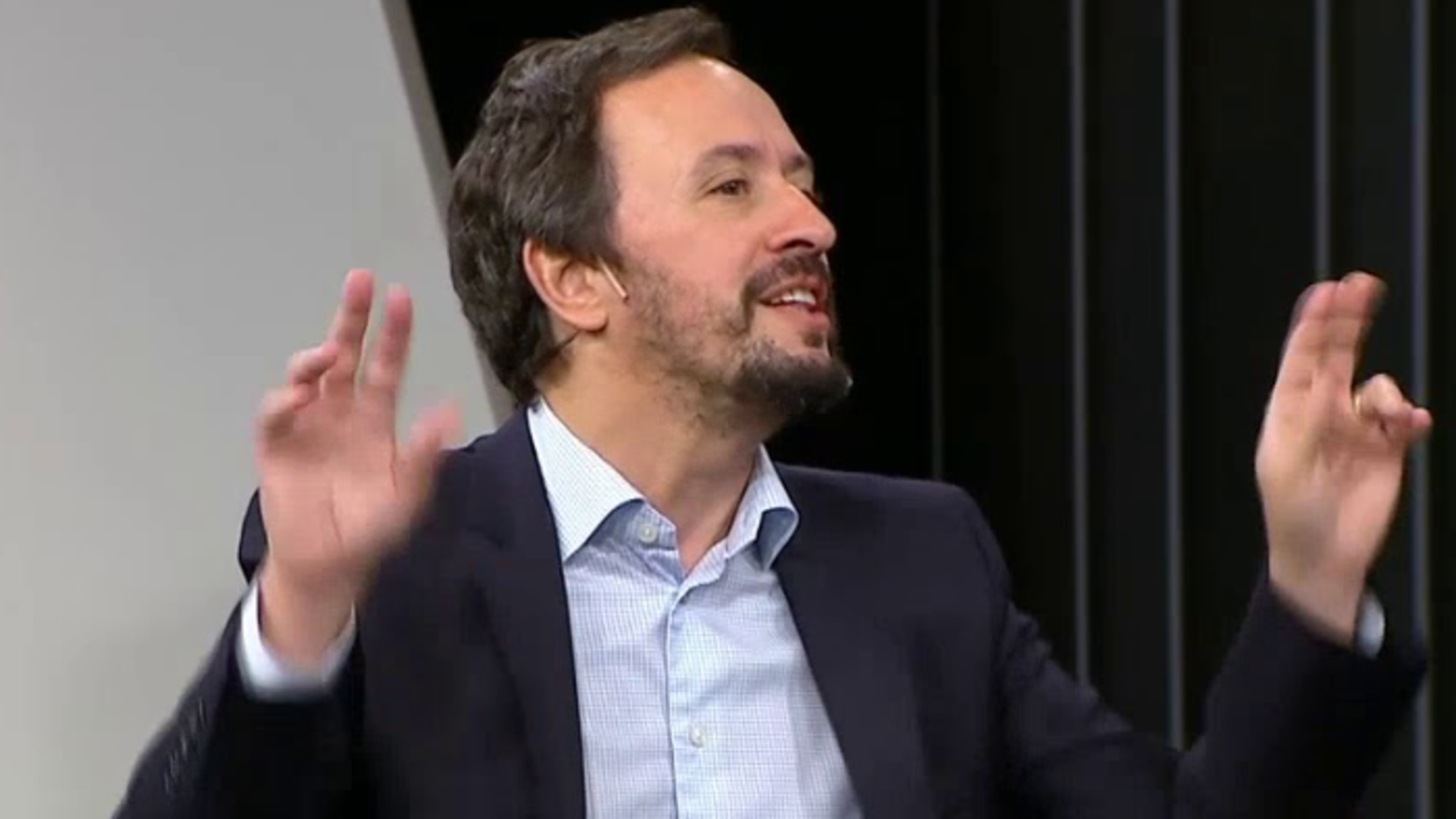
Facundo Nejamkis holds a degree in political science from the University of Buenos Aires and a master’s degree in Administration and Public Policy from the University of San Andrés. He is the director of Opina Argentina, a consulting firm specializing in public opinion surveys; a professor and researcher at CONICET; and vice rector of Guillermo Brown National University. Before devoting himself to analysis and consulting, he held positions in the Office of the Chief of Staff to the President during Cristina Kirchner’s administration and served as chief of staff to the Mercosur presidency under Chacho Álvarez.
What makes Nejamkis interesting—and what prompted this conversation—is precisely this dual trajectory: he knows power from the inside and chooses to comment on it from the outside. His analysis of Milei’s Argentina, the state of Peronism, and the role of public opinion carries the weight of someone who has seen how the inner workings of power operate and consciously decided not to go back in.
By Lucas Malaspina
The game is still wide open
How do you view what has been happening over the past year—these transformations that have been affecting Argentine society and politics?
I see a society undergoing a very complex process of change and transformation, but—unlike, perhaps, those who are die-hard supporters of one perspective or another—I don’t see the outcome as a foregone conclusion. I see a situation that is still very open, where the cards have not yet been dealt. Of course, today the political stage is dominated by the president. Milei has undoubtedly become the center of gravity of the Argentine political system. Everyone is taking a stance for or against him, and this is the defining factor in Argentine politics today. But I don’t know if this is here to stay, if it’s going to be like this for ten years, à la Menem, à la Kirchner. I don’t know if Milei has ushered in a new cycle of political hegemony or if this is a transition from a regime that lasted twenty years—one that emerged after the crisis of 2001, 2002, and 2003—and whether we’re actually heading toward something else and a different order. Milei has not yet been successful enough to say that he has ushered in a new cycle of political hegemony, one in which he is not only the organizing force behind politics but also brings about a structural transformation in the relationships between the economy, politics, society, and culture. I think that remains to be determined; it’s up for discussion and open to debate.
If you take a closer look at the ruling party, you see a project that appears very solid in terms of discourse, narrative, and social media—very well-articulated, with a strong presence in the media. And you look at the opposition and say: it lacks leadership; it lacks a political project. The only things that carry any weight seem rooted in the past, nostalgic. But this is just the beginning; there’s still a long way to go.
A while back, you said something very striking: “When Argentine society decides your time is up, the opposition comes together in five minutes.”
I think that’s true. Today you see an opposition that’s completely fragmented, disorganized, without a clear national image, and without clear leadership. It’s possible that the government will do well in next year’s elections. Now, it’s also true that if, between now and 2027, society feels that the agenda of change the President promised isn’t far-reaching enough, isn’t successful enough, doesn’t change their lives, or doesn’t improve their material living conditions—whether through government action or market forces—my sense is that society will form an opposition. We political scientists have this maxim: elections are won and lost by the ruling party. A ruling party can win, but it can also lose if it does things wrong. And then, when it loses, it loses to anyone.
Society looks for replacements; it seeks out alternative leaders. It doesn’t matter if those leaders aren’t prepared, aren’t qualified, or lack sufficient political clout. Society has done this many times, and I believe it would have no qualms about doing so with Milei if people feel he isn’t delivering on his promises. I get the feeling that Milei, with very little, could have a very good electoral outlook next year. But we’ll have to wait for the election process to unfold to see that firsthand.
You also pointed out that, yes, he could do very well in 2025, but that doesn’t mean he’ll stop being in the minority.
The thing is, if you do the math, even with a damn good election—let’s say the government gets between 40 and 45 points in a legislative election, which is a lot—it still won’t be enough to build a majority on its own in either chamber. So, this is a government that is necessarily forced, until the end of its term, to negotiate with other political groups to build a majority and pass laws.
So far, it has done well in three areas. It is the weakest government in legislative terms in history—comparable only to Irigoyen at one point—with just a handful of senators and a handful of representatives. And yet, it managed to pass the Ley Bases, which introduces very profound and structural changes. It wasn’t the 700 articles it wanted, but it passed a law with 300, including the RIGI. And it has still managed to keep DNU 70 in force, which also brought about very profound changes and was highly controversial: one chamber rejected it, but as long as both chambers do not reject it, it remains in effect.
The other two factors that have worked in the government’s favor are, first, restoring order on the streets, at a fairly low cost in terms of repression. What Macri couldn’t resolve in four years in office, Milei resolved in six months. And the other point is the reset of expectations: the idea that, even though things aren’t going well, the government is on the right track. There’s a significant portion of the population who, when you ask them in polls how they’re doing, say “like crap,” but they also say they believe things will be okay, that the government is on the right track. Those are Milei’s three major assets so far.

The end of the roadblocks and the crisis among social movements
Do you think the restoration of order on the streets is more closely linked to smear campaigns against social organizations than to repression? Or to what do you attribute this success?
It’s probably a combination of factors. I think there are three elements at play when it comes to street blockades. One is the erosion of social movements’ legitimacy due to a practice that is very inconvenient for the rest of the population getting around the city. My office is across from the Obelisk, and honestly, at one point I had to buy a little scooter to get to work because I couldn’t get there. Even if you take a sympathetic view and don’t support repression for repression’s sake, there comes a point when you say: this pisses me off; I want to be able to get to work in peace. They can’t constantly block the main thoroughfare, 9 de Julio Avenue.
So, there’s a decline in the legitimacy of that approach, combined with two factors: a government that’s willing to prevent it, even by threatening to use force. It’s not the same to go out and block the road when you know you’re going to get beaten to a pulp as it is when you know they won’t do anything to you. Then there were also mechanisms involving information about social programs that the government made public, and this had a demobilizing effect on the groups that controlled those social actors who had been carrying out the street mobilizations. The government repeatedly threatened to take legal action against those organizations, and I think that must have had a deterrent effect.
Regardless of whether you like the government or not, it is debatable that, to receive a social benefit, a person should have to turn to an organization that is not the state. Why can’t the state today, with the technology available and the ability to identify individuals, determine directly whether someone is entitled to a social benefit? Why does an association have to act as an intermediary?
And then it seems to me that society is also demobilized, beyond the specific role of social organizations. A society that embraces a culture that is perhaps a bit more individualistic, with a more critical view of the government and government intervention in the economy. A model that encourages individual solutions over collective ones. That also explains why the current climate is more demobilizing than mobilizing, even though there was a very significant mobilization for university education. But it was like a flash in the pan: it appeared—something that had never been seen before—and vanished just as quickly as it had appeared.
What do you think went wrong with social organizations when it came to standing up against these accusations?
I believe that representing a group based on electoral legitimacy is not the same as representing it based on the resources you provide to that group. In many cases, the almost anabolic growth of many of these social organizations has to do with how they manage and distribute resources. Political parties also distribute selective material incentives, but that’s not all: their origin lies in the representation of interests. Here, I’d say it’s almost the opposite: their representativeness depends solely on the distribution of those resources. And it’s questionable how representative these organizations are if those resources disappear. It has often been shown that, when they resort to electoral processes, they lack any representativeness whatsoever.
I think that’s something worth examining closely. Is there a genuine sense of identification, or is it actually a form of subordination based on a resource that this institution provides me—but if it doesn’t provide it, my loyalty is completely shattered?
The period that best explains Argentina’s crisis in recent years, culminating in Milei’s presidency, is 2001–2002, summed up in the slogan “Picket lines and pots and pans, the struggle is one”: the articulation between the caceroleros—the middle-class sectors, the savers who cursed the banks—and the piqueteros, the poor who had nothing to eat. That articulation led to a political and electoral coalition that became the Kirchner administration. Kirchnerism ultimately came to express that articulation.
Over time, that dynamic ended up reversing. For the former “caceroleros”—who may have enjoyed a certain degree of economic well-being during the good years of Kirchnerism—the “piqueteros” were no longer those poor people struggling to get by, but rather those who were collecting welfare benefits for doing nothing. As if the difficulty of integrating into the economy and finding a job requiring some level of skill were the responsibility of every person receiving benefits, rather than the result of an economy that fails to create enough quality jobs for its entire population. Therein lies a breakdown in the bonds of solidarity that partly explains the questioning of the state’s role.
That is why the political force that emerged from that anger in 2003–2004 was Kirchnerism: a force that cast the state in the role of repairing a wounded society. And in 2023, the political figure that emerged from that crisis was Javier Milei, who cast the state as the culprit for every ill. Each, in some way, expresses the mood and crisis of a different era.
Peronism without leadership or doctrinal renewal
How do you see Peronism moving forward? Where do you think it should go?
Peronism is a system of power structured around a leadership that guarantees two things: electoral success and success in government. That was Perón, that was Menem, and that was the Kirchners. An unusual event occurred in 2015: after the 2017 electoral defeat, in which Cristina lost the election in the province of Buenos Aires to Esteban Bullrich—who was essentially a creation of Durán Barba and not very popular at the time—Macri’s administration began to falter. So, society reframed the question: instead of thinking about how to put an end to Kirchnerism, it began to think about what to do with Macri. And it built an alternative to defeat him: Cristina with a touch of Alberto Fernández, with a bit of Peronism from the other side.

In that rapid return of Peronism to power, Peronism sidestepped the renewal process it had undergone at other times when a leadership came to an end. When Perón died, there was a chaotic period under Isabel, followed by renewal in the 1980s and the rise to power of a leader like Menem, who had a political agenda, won with nearly 50% of the vote, and governed for ten years. Something similar happened in 2003: another Peronist emerged who displaced Menem; Peronism competed internally; and that transition lasted until 2005, when Kirchner declared, “I’m the boss,” and led Peronism toward a politically successful project in electoral terms, which remained in power for three terms.
None of that happened with the return in 2019. We came back with the same people. Take a look at Alberto Fernández’s cabinet: all of them had been ministers or very senior officials in Cristina’s administration. A group that had been in politics for twenty years. And so, the most recent process not only led to electoral defeat but also resulted in the loss of one of the main attributes that sustained Peronism: they can say whatever they want about us, but we know how to manage power. Alberto Fernández did not build leadership; he did not know how to govern. He was constantly threatened by the figure of the vice president, who constantly made it clear that she—and not he—held the electoral legitimacy.
It was a very good campaign, but it was a bad administration. That’s what happens.
That’s right—it was very competitive in electoral terms, given the administration’s chaotic final days. I think Peronism today faces that dilemma. It lacks competitive leadership in electoral terms: none of the current figures can guarantee their base a victory in a presidential election. And it hasn’t developed any process to update its core ideas since its last time in power. When you listen to Cristina, what you generally hear is nostalgia for her time in office: “During my administration, we did this; income distribution was like that.” Without denying those figures, what I’m simply saying is that no one today can explain how that would be implemented in terms of public and economic policies, given the current state of the soybean market, Argentina’s level of debt, and our current inflation rate.
Peronism has to engage in this process of discussion. It’s not easy because it’s a fragmented movement with different factions, and I don’t know what incentives they have today to work in a coordinated manner and put together a unified political proposal. Especially if Milei doesn’t do badly, because then the prospect of returning to power will seem distant, and we’ll likely see each faction focusing more on its own game than on a collective one.
Kirchner, Milei, and the Problem of Initial Legitimacy
I’d like to ask you what you think Néstor Kirchner represented in terms of public opinion, because I don’t think people talk about that much these days.
First of all, to draw a connection between one thing and another: for me, the most important thing in political analysis is to look at the numbers and, as I call it, take a step back and be a little less emotional. To understand that there are no good guys and bad guys. Most analyses are skewed by the belief that “I’m good and the other person is bad.” I once went on a streaming show called Neura, and the people there were really angry. I exchanged ideas with Óscar Paset—a goalkeeper—and he was really angry, so I told him: Look, you shouldn’t think the other person is bad. The other person just sees things differently. You can be in favor, and the other person can be against, but that doesn’t mean the other person is a son of a bitch.
When you start analyzing politics with the realization that there are no good guys and bad guys, your perspective changes because it becomes much broader. To me, neither Macri nor Cristina is good or bad: they are politicians fighting for power, and each has strengths and shortcomings. So when you watch the game without that passion, Kirchner was, in that sense, a very interesting public-opinion phenomenon. He came to office with very low initial legitimacy: 20% of the vote and a twenty-point positive image rating.
Much lower than Milei’s.
Yes, much lower. Milei quickly went from the initial 30 points in the PASO to the 55 points he obtained in the runoff, and that is more or less the level of positive image he maintains. That gives him a very high floor for political debate: half the population supports his agenda of changes and transformations. Kirchner had to build his governing legitimacy through his performance in office, because his initial support was only 20%, 25%. And it must be acknowledged that he may be one of the presidents who left office with the highest approval ratings: he went from 20–25% to 70% by the time he left. That deserves credit. And he knew how to manage that capital: he left office with those numbers and put his wife forward as a candidate, creating the possibility of extending the political cycle beyond constitutional restrictions.

The Transition from Politics to Consulting
What was that transition like? You were in politics and then moved into consulting.
My first experience in politics was as a student activist in high school, at the Colegio Nacional Esteban Echeverría in Ramos Mejía. There, I was president of the Student Council—a wonderful political experience in the ’90s, in ’91 and ’92. Then I went to college, first to study law—I didn’t like it—and switched to political science. I studied political science; actually, I wanted to study law because back then they used to say: to be a politician, you have to be a lawyer; all presidents are lawyers.
In the ’90s, I became politically active at the university in what was then the Frente Grande, the FREPASO. I really liked Chacho Álvarez and his critical view of Menemism. We’re talking about the years between ’93 and ’98 or ’99. There was a whole series of innovative initiatives for a society that was somewhat disillusioned with politics. The Alianza was formed in response to public demand: the Radicals and FREPASO would go out on the streets, and people would say, “Join forces to get rid of Menem.”
After Chacho Álvarez left the vice presidency, I began working with him; I taught classes with him at the university; and when he served as president of Mercosur in Uruguay, I worked with him from 2005 to 2010, traveling back and forth to Montevideo as chief of staff to the Mercosur presidency. It was a wonderful experience: I witnessed the most politically dynamic phase of that integration process, during the time of Tabaré Vázquez, Chávez, Lula, and Kirchner. It seemed as though integration was an unstoppable force. Later, I realized that politics sometimes makes a lot of noise, but in practice, things don’t move forward as much.
Later, I had a friend who worked with Néstor Kirchner, and I found myself out of a job when Kirchner took the position of Secretary General of UNASUR. He said to me, “You have experience—come work with us.” So I joined that team. Then Kirchner passed away, and this friend of mine was appointed chief of staff to President Cristina Kirchner, and he invited me to work there. I worked in the government until 2013, in various areas: strategic communications, among other topics. And one of the areas I focused on during election campaigns was analyzing polls, given my background. The numbers were fascinating.
A year before leaving the government, I began to feel uncomfortable with politics. It was a personal feeling; I don’t attribute it to anyone or anything in particular. So, I went back to therapy.
Because of the pace, perhaps?
It could be the pace, the pressures, or the way people fight for power. It was a very tense administration. I’m not that kind of person. I’m active on social media because I don’t like being left out—it would feel like not having a TV today—but I don’t feel part of that aggressive dynamic that dominates politics today. That’s why I feel I’m someone who can go on La Nación+ or TN to offer political analysis, but if I’m invited to C5N, I can do that too. I can talk with Pablo Duggan on Radio 10. I try to set my personal passions aside and offer political analysis that’s as sincere as possible. And I think my advantage—what sets me apart—is precisely having had that experience and knowing a little bit about how things work on both sides of the counter.
I like this side better. I understand that the other side is about being in the action, and this side is about commenting on it—it’s not the same thing. It’s as if you were asking me: Which would you rather be, Víctor Hugo Morales or Maradona scoring that goal against the English? A soccer player experiences an adrenaline rush that no one commenting from the sidelines can ever have, but has a shorter career. So, I feel that politics is very draining, very cutthroat, very violent, and it doesn’t fit my style. If you tell me, “Stand here and trade insults with me,” I’m not going to shine. I’m not a fighting cock. If you tell me, “Let’s talk for an hour, let’s reflect,” I think that brings out the best in Facundo.
Recommended Books and Colleagues
Which books do you feel have accompanied you and sparked your passion for analyzing and evaluating strategies?
I couldn’t say for sure. I like literature. I found Serotonina, by Houellebecq, very interesting. Also by Houellebecq, Sumisión, which raises the possibility of a Muslim president in France: it’s very interesting because it portrays the crisis Europe is going through.

Among the most recent books, I think El mago del Kremlin by Giuliano da Empoli is excellent. It’s excellent because it accurately depicts the role of a political analyst in advising the government and in political communication. And then there are some excellent books by Mario Riorda, a specialist in political communication whom I follow closely. Durán Barba has written some great books as well: El arte de ganar is excellent. But in general, experience has shaped me more than literature.
If you had to recommend a professional you’ve worked with—someone you trust—who would it be?
Mario Riorda, among the Argentines, strikes me as one of the very best—the most sophisticated, the most knowledgeable. And then there’s a whole generation of colleagues dedicated to surveys and public opinion studies who are highly respected. Federico Aurelio has done a great job carrying on his father’s legacy. Eduardo Fidanza—it’s always a pleasure to read his work. Shila Vilker, from Trespuntozero, is a great colleague. Lucas Romero and Gustavo Córdoba, from Zubán Córdoba y Asociados. Pablo Knopoff, from Isonomía: whenever you talk to him, he tells you something new, something different.
I think there’s a strong generation of colleagues, although the market is complex because it’s so fragmented. Everyone wants to start their own company. You follow Pagni’s show, and every Monday he cites a different polling firm. You read Paladini in Clarín, and every day he runs a story with a polling firm, and you ask yourself, “Who is this one?” On the one hand, that’s good because it speaks to a very dynamic market, but it also makes it difficult to invest in research. It would be good sometimes to try to build stronger, more solid companies that can delve deeper into error detection and the incorporation of new technologies. That’s a topic for another hour-long discussion about the impact of technological changes and people’s reactions to being polled on their cell phones as a way of measuring public opinion.


