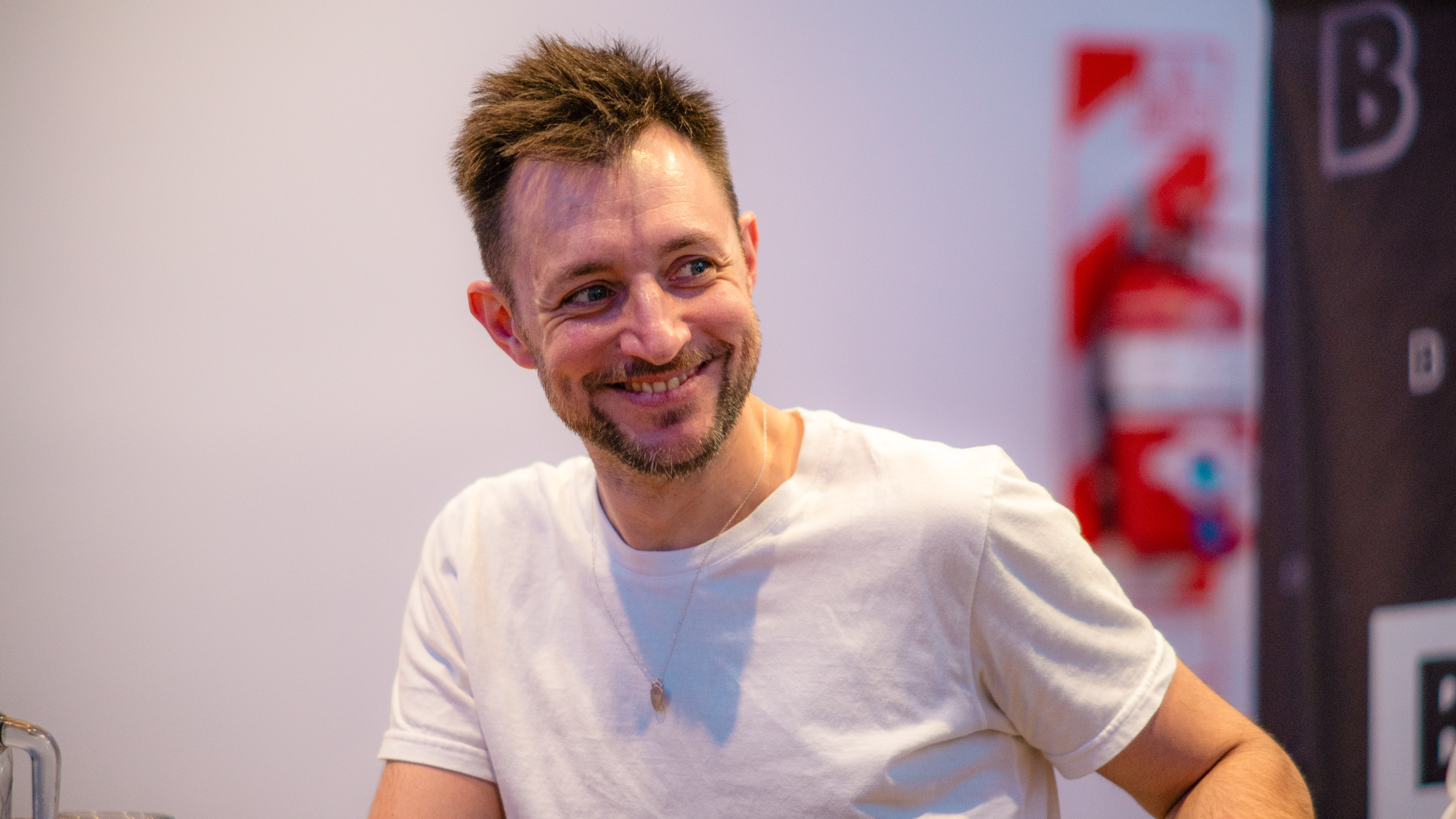
He is a political consultant who identifies with Peronism and has a significant track record in digital media, beginning with the founding of Dinamarca Public Relations in 2017. He remained there until 2022. It was a very innovative agency at the time. He was also the founder of El Canciller and currently leads Esto es Blender, a streaming channel we’re all familiar with that generates a great deal of interest.
Diego Abatecola’s Early Career in Politics and the Media
Diego, what led you to get involved in political consulting? Was that before you got into media, or afterward?
I come from a deeply Peronist political family, so I was always connected to the world of political activism and, through that, to the media. One of my parents is a film director, and my mother always worked in the media world, including film and theater. Later there was work on regional initiatives involving Mercosur’s specialized film commission, and so on, so the family was always very immersed in that world. Media, naturally, was something we consumed as a matter of course. Cameras, Moviolas—these are old things; I’m 41, but they were around then. From there, it was a fairly natural path because those subjects interested me. For a long time I worked on political matters, gradually moved closer to the media, and by one of those twists of fate ended up working for a time in the Chamber of Deputies as an advisor to María Lenz, a colleague and friend I care for deeply, who was my great political mentor. We happened to deal not only with the Media Law but also with the committees responsible for media issues.
That was pretty irrelevant in terms of fully understanding and discussing those issues; it was a natural journey I gradually got involved in, and later, a very in-depth exploration of digital and social media dynamics, because that was the time when all the platforms were starting to emerge, and I was, I’d say, just the right age to dive into that. So, drawing on all of that, I developed—first a starting point, then a perspective, and so on—and engaged in what I’d call a largely self-taught exploration of the political world. And from there, as I grew professionally and through my involvement in politics, I ended up working on several campaigns—first in smaller roles, then moving up the ranks, and eventually taking on a much more prominent role in Scioli’s 2015 campaign, which allowed me to learn, among other things, what was being done well in the digital realm and what was being done poorly. And following that defeat—which, like any defeat, is always important for rebuilding and rethinking—the idea emerged, along with a business partner at the time (my former partner, with whom I eventually went our separate ways), that we needed to start something of our own. So we decided to create the Dinamarca agency based on what we’d been observing—what could be done in the digital realm.
And then there was the media outlet, El Canciller, which took off quickly and also had a very agile approach to digital content. It was the culmination of all the media experience I had accumulated, put into building an outlet of our own. Later I began building others for outside clients, in other places, and it became day-to-day work. The agency started out distributing digital content—that is, figuring out how to distribute content through profiles and outside content distributors—so that you could reach different communities and audiences with the message of a candidate, an institution, or whatever it might be. It ended up becoming an agency focused on positioning, consulting, analysis, and so on—which was sort of what we were already doing naturally, because I always say, and believe, that to build a digital strategy, you need a solid overall strategy. Today everything is more interconnected than it was back then, when we were still in the 1.0 era. That was a while ago, but, in a way, a very clear strategy for positioning, objectives, and where you want to go allows you to organize the work related to press, media, positioning, organization, digital—everything. As a result, the agency began to take a more 360-degree approach, and that journey led me to work with clients for a long time.
So you entered the world of consulting and media, partly because of your family and partly out of a sense of commitment. What was that political commitment like? Did you ever become an activist in any organization?
Yes, for a long time, always in PJ organizations. I had my own group many years ago—really, many years ago. Now that I do the math, I’d rather not, but it was in 2008–2009 and was called Agrupación Fermín Chávez. It was closely connected, obviously, as the name suggests, with national thought and that line of thinking. So in that sense it was also a natural process, one that later faded, as everything does over time: when you take on more representative roles and do other things, it gets pushed to the side. But it was an important part of my life, because it was also closely tied to my family dynamics. My father was a highly regarded Peronist film director, Gerardo Vallejo, who belonged to the Cine Liberación group with Pino Solanas and Octavio Getino. He filmed Perón in exile, so we absorbed Peronism from a very young age. It made for a complex set of conversations and actions. My mother—she passed away—always told an anecdote from when I was four. I had two fathers who raised me, one of them my biological father. One was a die-hard Boca fan and the other was very Peronist. The other was also a Peronist, but one was clearly very peruca, while the other brought the Boca side into it.
So, one day when I was four years old, I was playing with the Thundercats—I remember those little action figures—and Gerardo, who was one of the anti-imperialists and very much a Peronist of that era, would say, “No, those toys are Yankees, or whatever.” And I was four or five years old—I don’t remember exactly—and I’d say, “Relax, Dad, the Thundercats are from Boca and they’re Peronists.” I was kind of working along party lines. I’d say, “We have to bring this into line or all hell will break loose.” So yeah, it’s always been an important part of my life. Like all the big things that matter to you in life, sometimes you go through a crisis. I think Peronism is in a deep crisis, and because of that, I’m going through my own crisis, where I act like a sort of “Protestant Peronist.” I’m nailing my theses to the church door like Luther, because sometimes it seems to me that the Peronism that represents me is based on a different doctrine—one that I believe has nothing to do with this latest snapshot. I think the bulk of the current leadership has become the very oligarchy that early Peronism would have fought against in general terms—an oligarchy of caste, privilege, and a whole host of other things.
And I think that can make you feel less represented today. But, well, the doctrine is always in your heart.
Peronism and Digital Communication
You mentioned Scioli’s 2015 campaign.
Yes, it still hurts.
What is the relationship between Peronism and digital communication, and how do you see that relationship evolving?
It’s a particular situation, and there is always a sense that this is difficult. Generally, in recent years, Peronism has often been seen as the movement that had the most difficulty, while forces outside the PRO back then—or Milei’s own movement now—were seen as digitally powerful. I think that is relatively true. I say “relatively” because, to some extent, they made better use of the tools, but I also think it has to do not only with developing expertise but with daring to fish in those waters. I think there is a problem with Peronism in general: it has become a bit gray and a bit old across the board. That also carries over into communication and therefore into strategies. And I think that, instead of looking for the natural places where those conversations happen, they always want to create their own, which makes them even more of a niche unto themselves. There are particular cases I see here in streaming—outlets that are Peronist through and through and are organized by political groups, I mean. And obviously, they have trouble building an audience.
When there are other platforms hosting the same discussions—I don’t know, take the case of Pedro Rosemblat, who’s a friend of mine, by the way, and a very talented guy with Gelatina—you see a successful process of creating a space for conversation based on a perspective that naturally resonates with an audience that identifies ideologically, politically, or however you want to put it. And I think those are the models to aim for. There’s this “I built it, it’s mine, it’s mine” mentality, and that pulls you inward. And I think part of the digital world is understanding that, for it to work, you need to be part of a conversation organically and move within communities that are already established, rather than think about creating your own. That “niche-ifies” you and makes things harder. I don’t know whether “niche-ifies” is a real word, but it sounds good.
I was thinking a lot about the 2015 campaign. Did you see that there was a conversation between Julián Gallo, who ran the social media for the Macri camp, and César Gazzo Huck, who ran the social media for Scioli?
That’s right.
Gazzo-Huck said: “I was trying to explain to the mayors that people no longer looked at the posters you see between train stations; instead, while they’re traveling, they’re looking at their cell phones. They didn’t pay me much attention, and social media more or less followed the press.” So, obviously, in that sense, yes, the Macri camp made better use of those tools at the time. Now there’s also the view that, looking back at last year, 2023 was a difficult year for Juntos por el Cambio, and today it practically no longer exists as such. And one could say that was part of it, but it was also political. Exactly. How do you see that?
Let me take it step by step. First, I think what seems new today in that conversation—the idea that people are looking at their phones on the train—was actually novel at the time César was saying it, and I know him personally. It was really hard to explain the importance of the logic behind platforms. In fact, the whole Obama experience—which had become all the rage at the time—was revolutionary in general terms and had blown everyone’s minds; everyone was copying him, but broadly speaking, it was hard to translate that into the dynamics of political leadership. In particular, I think that, in general, political leaders are usually the ones least at the forefront of these things—except for the best ones or those with the most vision for the logic of communication. So, that slows down the processes. Then, what you’re saying—I totally agree—I was mentioning it to you off the air a little while ago: people always think that problems are solved through communication rather than through politics. Communication doesn’t solve a political problem. So, in the case of Alberto’s administration, for example, if you have skyrocketing inflation, wage issues, the accumulated frustration from the pandemic, and so on, it’s unlikely that a good social media campaign can make up for what’s lacking in political terms.
Not to mention the PRO, which had lost its sense of identity above all else, because the reality is that it was swallowed up by the disruptive right—or they were all feeding from the same fishbowl, and the others gobbled it up. I think it’s a party whose identity has become completely blurred; it doesn’t know where it’s headed or what it’s going to do. If Peronism is reeling, imagine the PRO or Juntos por el Cambio. And I don’t think that depends specifically on digital media or the platform. What I do believe is that communication in general follows a sedimentary approach: when you start a campaign, you try to be everywhere worth being, and you should put more effort into the places that are most strategic for your goals. That means there can be a poster; it means you can work with traditional media; it means you can develop the digital side. But I think the mistake lies in believing the magic formula is: “Hey, I’ll open TikTok, boom, boom, I’m off and running, done,” when you haven’t resolved the underlying political problem, the premise, the objective, or the strategy for where you’re headed.
Perón, Menem, Duhalde, Néstor, and Cristina Kirchner
What do you take away from the figure of Perón? What does Peronism mean to you? Perhaps they’re different things.
I believe Peronism has transcended Perón himself, but Perón is the great rallying figure behind it. I believe Perón is the most important—or one of the most important—figures of the 20th century, at least in the Southern Hemisphere. And I believe he is particularly fundamental to Argentina, because he built an Argentina that is at risk today but still exists: an Argentina of upward social mobility, the only country in Latin America with a middle class. There is a standing joke in Peronism about NPP countries: countries where Perón never happened, which generally have wealth concentrated among a very few people and widespread poverty. I believe the risk we have faced over the last 12 or 15 years is that of becoming a pre-Peronist country: bringing back a logic in which wealth is concentrated among a very few well-connected people who form part of the system’s oligarchy, while poverty grows and becomes endemic. It is one thing to have a country with poor people, which Argentina has always had; it is another to have a country with structural poverty, something Perón had not solved but had set on a path toward resolution. Workers had rights, access to housing, and many other things that are being lost over time.
So I believe that memory persists. And I also believe that the challenge Peronism faces today is whether it is alive or dead. That is, whether it truly is a transformative political force that, grounded in its values, addresses the needs and demands of a large part of the population, or whether it is merely an appealing collective imaginary. For a long time people have engaged in that exercise, though without wanting to turn Perón into a kind of Old Vizcacha. So they quote his phrases as if they applied to everything. The reality, however, is that there was a much deeper, much more analytical and philosophical body of thought. There was a much deeper intellectual framework in that sense. That is why I believe that—even after many have misused Peronism or the Peronist banner—it remains alive as a powerful force. I think this has to do with Perón’s wisdom, even before his death, when he said, “My only heir is the people”: it is among the people that Peronism remains alive.


