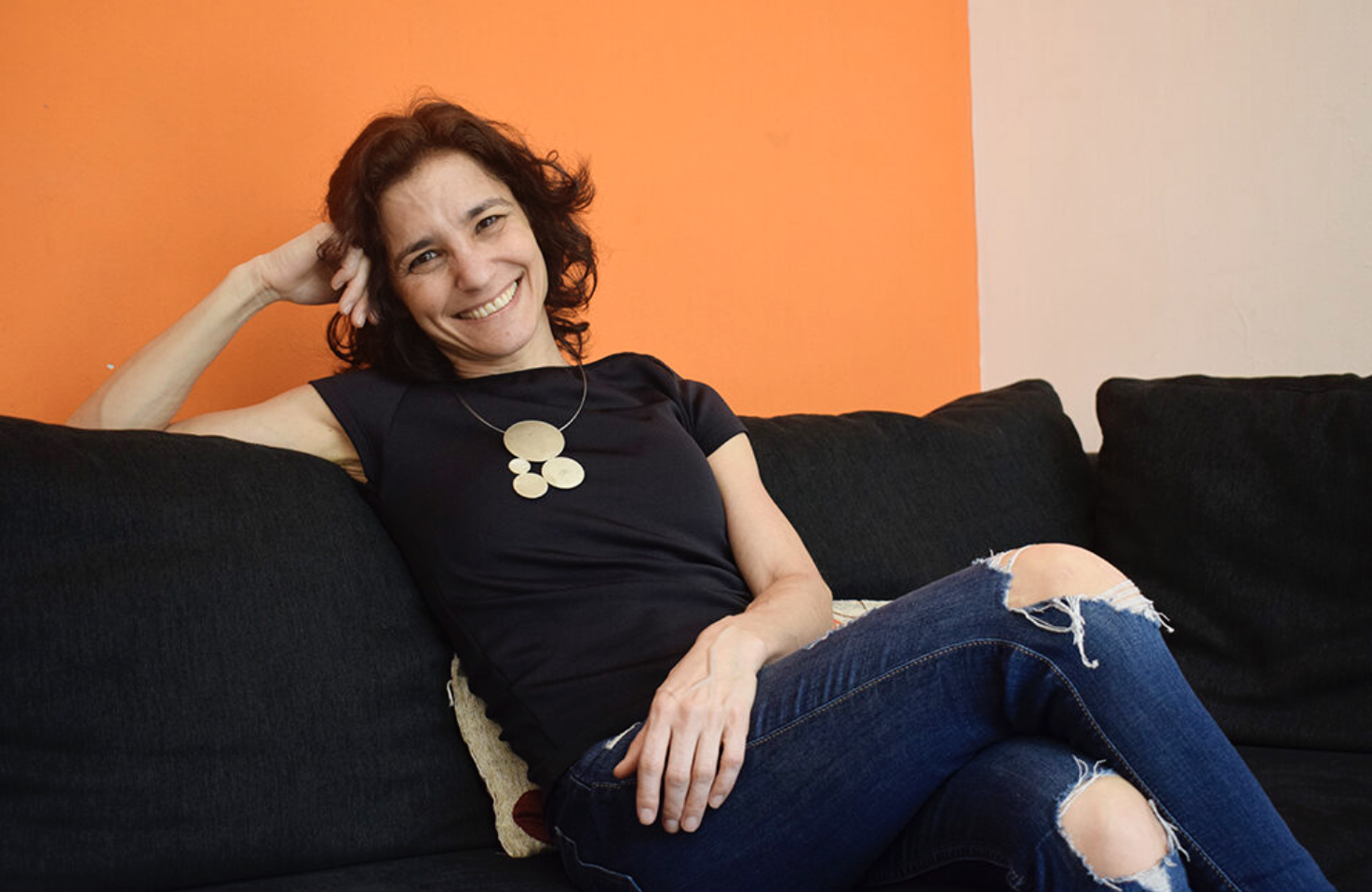
The first time I saw her was in 2017, during a graduate program at FLACSO, and I was impressed by her knowledge and teaching style. Natalia Aruguete is a researcher at CONICET, holds a Ph.D. in Social Sciences from the National University of Quilmes—where she also teaches—and is a professor at Austral University. She contributes columns and articles to Página 12 and to Le Monde Diplomatique. She is one of Latin America’s leading academic voices in the fields of political communication, agenda-setting, and social media.
Her career began in journalism and evolved into a research career that includes books such as Teorías de la Opinión Pública (2012), El poder de la agenda (2015), Fake News, Trolls y otros Encantos (2020)—co-authored with Ernesto Calvo—and her most recent work, Nosotros contra ellos (2023), also with Calvo, published by Siglo XXI Editores. Throughout this journey, Natalia has broadened her field of study from traditional media to the digital ecosystem, platforms, and the mechanisms that explain why people become active, polarized, or silent in public debate.
The talk began with the most immediate present—the Argentine political context, the spiral of silence, and the Milei administration’s communication strategy—and concluded with more fundamental questions: what it means to be a researcher with a political stance, how the media has changed, and what she is focusing on now.
By Lucas Malaspina

Cultural Change and Entrepreneurship
How are you feeling today?
Right now, I feel good because the sun is out and it’s starting to get warmer. But if we look at the bigger picture, I’m swimming against the current, like many Argentines, trying to resist certain attacks that place us—in the eyes of this government and a significant portion of the population—among the political caste. I also think it’s important to understand that, for many people, we—the ones with stable jobs, the ones who have rights that they see as privileges—are the political caste. So it’s not just painful to see the government’s attack on research, researchers, and university professors; it’s also painful that, to some extent, this is applauded by a segment of the population.
Why do you think that happens?
I have the sense that there is clearly a cultural shift taking place. In part, this cultural shift has to do with a loss of faith in stability as a labor right, a loss of faith in regular pay, and in labor rights themselves—as if it were acceptable to have to live with this instability and this constant sense of turmoil. I imagine that a large part of society, particularly the younger generations, envision entering the workforce from a very dynamic perspective—if we want to use a euphemism with positive connotations. That dynamism works against stability, and it’s also true that the new generations entering the workforce don’t know what a year-end bonus is, what paid vacation is, or what the continued validity of collective bargaining agreements means. There’s no awareness of these things, and I’m not so sure they’re even viewed as rights to be attained.
There’s a word that strikes me as key in what you’re saying: entrepreneur. How do you see it?
I have absolutely nothing against entrepreneurship. The problem arises when it’s portrayed as something positive, when in reality, in many cases, it’s the only way out in the face of job instability, the erosion of rights, and job losses without any compensation or recognition. And above all, there are issues related to social security and the ability to access a pension. These issues are bound to come to a head at some point. I remember that something like this happened back in 2002: half of the workers of retirement age were left without the possibility of accessing a pension. That was a total catastrophe. So, embracing entrepreneurship and striking out on one’s own could also become, in the near future, a serious problem in terms of social sustainability.
When you see that an individualistic narrative is increasingly taking hold among the population, do you see any countervailing factors or countertrends?
Every movement faces resistance and counter-movements. It seems to me that one of the issues that frightens many of us right now is that this individualistic, meritocratic, entrepreneurial mindset has become mainstream. And it has become mainstream in part because those who championed this cultural agenda have moved from the margins: they are no longer on the fringes; now they hold power—cultural power, in particular. It seems to me that this is much more firmly established than it was during Mauricio Macri’s administration, when resistance was still a bit stronger and more persistent over time. What happened—like two sides of the same coin—is this: on the one hand, the mainstreaming of those who promoted this worldview. And on the other, the disillusionment of those who held a very different worldview. The enthusiastic ones take action, forge ahead, and dominate the scene. Those left disheartened lose their enthusiasm and stop participating. The winning half is enthusiastic and overrepresented in public discourse. The rest fall silent—out of shame, out of sadness, because they can’t find a way to channel their values, and because there is no leadership to represent them.

The Spiral of Silence and the Government’s Communication Strategy
Could that have something to do with the spiral of silence?
The spiral of silence posits that when one feels that one’s agenda, framing, values, and discourse are in the minority, there is a greater propensity to remain silent. In the face of one’s silence, those who are more vocal become more represented in that scenario. But I believe that right now the spiral of silence is being fueled by a discursive onslaught—both digital and non-digital, political and social—that comes from multiple dimensions: these are coordinated, systematic, and very clearly targeted attacks. All of this not only causes people to remain silent because they feel they are in the minority, but also makes them feel under attack and causes them to withdraw from the debate out of fear. The levels of self-censorship we’re seeing among certain political leaders, a significant segment of the journalism community—particularly female journalists—a segment of the scientific community, and a segment of government employees are very persistent, very systematic, and very widespread. Ultimately, this type of attack controls the population by determining who is allowed to speak and, consequently, how the agenda is controlled.
You’re an expert on the topic of the agenda. What have you observed during these past few months of Javier Milei’s administration?
We’ve come from previous periods and administrations where it was certainly difficult for governments to set their own agendas. During Alberto Fernández’s administration, the agenda was clearly in the hands of the opposition. This also happened during Macri’s administration: there was an understanding of the digital ecosystem, but at critical junctures, the opposition took the lead. The Santiago Maldonado case, although it ultimately played out in line with the government’s desired narrative, sparked 77 or 78 days of media chaos. The “two-for-one” measure was an absolute defeat, leading to one of the largest protests in the history of democracy. The massive utility-rate hike was crystal clear. And the abortion issue was, in terms of public communication, an absolute triumph, even though it was rejected by the Senate in 2018. Right now, there’s a hyper-activation of the agenda by the ruling party and its digital actors. What we’re seeing throughout this initial phase is an enormous ability to permanently set the agenda and ensure that everything revolves around discussing what Javier Milei’s inner circle decides.
Were there any issues where that didn’t happen? I’m thinking of higher education and retirees.
I don’t think that’s exactly the case. When analyzing communicational and political events—which, for me, are part of the same thing—we must distinguish between critical events of recomposition, where something changes at the political level, and critical events of restoration, where everything goes back to square one. In neither case—the university march nor the retirees’ march—did what was generated in discursive and political terms manage to change the course of public policy decisions. In the case of the universities, nothing was resolved in the slightest, starting with faculty salaries, which are below the poverty line. In the case of retirees, despite a substantial bloc having voted in favor of the pension increase, a large majority ultimately voted in favor of the veto. What I’m seeing is that these communication battles remain at that level and are co-opted, absorbed, and channeled in favor of the government. And then nothing happens.
And what about the issue of executive branch and congressional salaries?
What happened is that they backtracked, but Milei capitalized on it very well, because it wasn’t a single event. You have the salary increase for the Executive Branch and the salary increase in Congress. In the first case, they backtrack, and Milei emerges unscathed. In the second case, he is the one who says those salary increases are being reversed. So he comes across as honest, while the others reinforce their image as part of the political caste. To me, rhetorically speaking, he’s capitalized on this very well. And there’s something I find significant: there’s a difference between Milei’s image and the image of the policies the government is implementing. If you can get the president to differentiate himself and distance himself from the government’s image, that’s an effective communication strategy. I don’t know how long this will last, because it’s no longer just about the salary stability of public employees or CONICET researchers—they’re now affecting utility rates and public transportation fares. That affects everyone. It may have its limits. What does strike me, however, is that there is a decoupling taking place between Milei’s agendas and the agendas that are beginning to emerge among his own voters. That decoupling could gradually become erosive for the government.
Research, Political Stance, and Career
Do you consider yourself an activist researcher? Is neutrality necessary to conduct good research?
It struck me as incongruous that you placed me in the category of “activist.” I have absolutely nothing against being one. The thing is, it’s a term that has been so debased that it can be dangerous and counterproductive to use it in those terms. I do believe, clearly, that no delineation of an object of study is innocuous. No researcher, no cultural being, is devoid of a stance toward life, toward events, toward political leadership, and of a historical background that leads one to adopt a particular stance. And it is from that standpoint that they choose their objects of study: they don’t just fall from the sky. The objects of study that we Argentine researchers choose differ, to a certain extent, from those researchers in Spain or the United States might choose, despite the extensive exchanges and international collaborative projects. What I certainly do not believe is that a researcher, in order to be a good researcher, must be neutral. I do not believe that is a necessary condition for any cultural subject.
How did you become the researcher you are today?

I came into research through journalism. I completed my undergraduate studies in 2001–2002, in the midst of the crisis. I submitted my thesis on December 17; on the 19th, everything exploded. I graduated in March 2002. I began doing a great deal of journalistic work. In early 2003, I interviewed Daniel Aspiazu for Página 12; at the time, he worked in FLACSO’s economics department. He encouraged me to apply to CONICET. Since my background was in communication and he was an economist, I created a kind of convergence. I had recently met Martín Becerra and had been dazzled by him. I applied to CONICET with Martín as my supervisor and Daniel as co-supervisor, and that is where the path that has brought me to today began. I have been at CONICET for 20 years.
I was born in the capital; I lived with my grandmother for a year while my parents built their house in Gregorio de Laferrere. My dad was a doctor in that neighborhood and was politically active. A group of friends set up a cultural center focused on educating people and helping the neighborhood: my father taught nursing classes, and my mother provided academic support. I spent my first 13 years in Laferrere, then moved to Ramos Mejía and attended Aldo Rico in Morón. When I started the CBC, I also began working as a student supervisor and later as a teacher at an adult high school in Laferrere. I’d get home at 11 p.m. and wake up at a quarter to five. I was working at FM La Tribu at the time, which is where I met my current partner 26 years ago. I taught in Laferrere for eight or nine years, until I joined CONICET and had to give up those teaching hours because the positions were incompatible.
The Media, Platforms, and New Political Communication
From your first book to Nosotros contra ellos, how did you experience the transformations in communication?
Clearly, there is a profound, sweeping change that is here to stay. One of the factors most affected by this change is the media’s former role as the central gatekeeper in setting the agenda. And one of my core convictions in this regard is that we must stop being naive enough to think that the media still sets the agenda today. On the contrary, I believe they are at a disadvantage when it comes to doing so. First, because they aren’t read, they don’t generate interest, and they aren’t recognized as a source of information—not even intentionally. They aren’t recognized because the way we consume content causes us to lose sight of which source is providing that content. News consumption is marked by distraction and incidental exposure: whoever the source may be that provided the news that reached us in a fragmented way—while we were doing something else, through algorithms—all of that means we find out about something while standing in line at the supermarket and then don’t even remember the full story, let alone who the source was.
So, you’re talking about, for example: I’m in the bathroom and I see I got a DM on Instagram. Or I go to the grocery store and see a WhatsApp message with a link…
Exactly. Plus, you’re dividing your attention among multiple things at the same time, including a news story. What happens next is when someone asks you, “What happened?” and you don’t know. I know it was something about Bahía Blanca, and you don’t even know who the parties in conflict were—I’m not even asking you what the dispute was about. Recently, I participated in focus groups that were homogeneous in terms of vote choice. In the group with the strongest affinity for Mileism, there were enormous difficulties in piecing together the news stories. In the Massa-aligned group, there was a much greater ability to reconstruct the full news stories, identify the source, and even come up with conspiracy theories against hostile media outlets. This has to do with a markedly different level of interest in the news event. That’s one of the main things I see: a decline in the media’s ability to influence people.
And how does that relate to the media’s editorial decisions?
Media outlets decide what to cover based on metrics that tell them the level of engagement. And those metrics don’t just reflect what’s performing well in their own content; they also involve looking at what’s performing well in other media outlets. If something is performing well elsewhere, the outlet will pick it up, even if it has already covered it before. There is a degree of subjugation both in terms of what to publish and how to write it. And they’re also competing with platforms that constantly penalize them: once they figure out the Google News algorithm to optimize their ranking, the algorithms change. Once they figure out what visual style and what kinds of events to post on social media, the platforms penalize them and stop sending them traffic. Furthermore, they’ve already lost that omnipresent and nearly unchallenged power they had several decades ago: what you see on a media outlet’s front page is just the institutional brand. After that, the outlet is thinking about 18 agendas—one for each social network and another for Google.
Nosotros contra ellos: From the Macro to the Micro
What are the main conclusions of Nosotros contra ellos? What does this book contribute that the previous one did not?
In Fake News, Trolls y otros Encantos we took a macro view, mapping out where the various participants in the conversation were located. Since we were able to analyze big data at that time—using data from Twitter’s API—we could see where the main authorities were positioned in the conversation and who was setting the agenda: the media, political figures, and activists. Now that access is no longer possible or is economically prohibitive. Nosotros contra ellos offers a micro-level perspective on what motivates us to interact on social media. We work primarily with survey experiments: whereas before we viewed the conversation from a bird’s-eye view, now we examine—through the lenses of political psychology and social psychology—how social media users react to controlled stimuli. This allows us to understand what we were mapping before: we saw the map, but we couldn’t know why people did what they did. Today, we can begin to understand why someone engages with or ignores information, and why certain types of messages polarize people politically and emotionally.
In other words, in Fake News we could see how clusters or opposing communities form, and in Nosotros contra ellos we can see what incentives users have to engage in those conversations.
Exactly. And what makes them share a message, respond to it, or ignore it. The problem is that now we cannot map that, and this is no minor point. Elon Musk’s decision to prevent the conversation from being mapped is a macro-political and geopolitical decision, because this was a tool used in academia without any subsequent strategic political use. Conversation on Twitter fell by between 15 and 20% compared with previous years, and part of that decline was replaced by cyborg accounts that coordinate systematically and artificially to generate conversation in highly sophisticated ways. Artificial intelligence not only allows you to identify what kinds of conversations are taking place in different regions of the network and intervene in them; it also allows you, to some extent, to circumvent fact-checking organizations. What we are now seeing is a high level of toxicity driven not necessarily by fake news or blatant falsehoods, but by highly aggressive conversations. And how do you limit them, especially when the owner of the X platform believes in free-speech libertarianism—an absolutely spurious and opportunistic use of that concept?
Closing
To wrap up: What has been catching your attention lately? Where is your intellectual inquiry headed?
It seems to me that one of the things that’s really striking me right now has to do with the reaction of certain groups, certain organizations, and certain intellectuals to the levels of digital violence we’re witnessing—which has a massive gender component. A report was recently released by Argentine journalists on digital violence and cyberbullying—issues of which many of them have been victims. An important report by Amnesty International is currently being finalized. There’s also one from Chequeado. There is growing interest in this issue. I don’t know if it’s long overdue or if the rise of Javier Milei’s government and the cultural backlash surrounding advances in civil rights served as the catalyst. But I think it’s something that’s in the air, and hopefully we can make progress on it—draw attention to it, raise its profile, and engage a significant portion of Argentine society both intellectually and emotionally.


