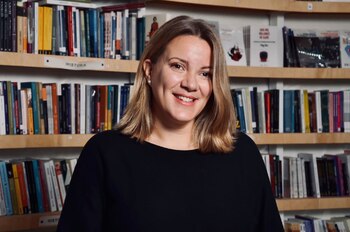
We spoke with sociologist and consultant Daniela Barbieri about the work of Pulsar UBA, the impact of presidential debates, shifts in presidential approval ratings, and the role of research in political communication.
Today we’re joined by Daniela Barbieri, a sociologist from the University of Buenos Aires with a master’s degree from George Washington University (GWU). Daniela is involved in several initiatives: she directs the Barda agency, leads the Pulsar UBA observatory—which has just launched a series of studies on the social beliefs of Argentines—and co-edited the book Debatir para presidir (Eudeba), based on research into presidential debates in Argentina. In addition, together with Augusto Reina, Facundo Cruz, and a large team, she has been working on a new program regarding presidential approval ratings. Daniela, thank you for being here.
Thank you very much to you and the team for the invitation; that was a great presentation.
Let’s start with a recent case. The presidential debate between Biden and Trump generated a great deal of commentary, especially regarding whether or not Biden was fit to remain a candidate. What did you observe in that debate?
It was a turning point. The debate exposed Biden’s health condition and left him severely weakened, to the point where he had to withdraw his candidacy. This contradicts years of American research suggesting that debates barely shift small margins. This time, we saw how trends shifted dramatically after the debate. And there’s an additional factor: the digital conversation. The wave of memes about Biden amplified the impact. The debate is no longer just the hour and a half in front of the camera—it’s everything that circulates afterward.
You at Pulsar UBA actually researched the impact of debates in Argentina. How did that research agenda come about?
We started in 2019, the first year the debates were organized by the National Electoral Chamber rather than through agreements among television networks. It was an opportunity to begin generating our own data, because in Argentina, almost everything said about debates came from foreign literature. So we set up a real-time experimental study: quantitative, qualitative, and digital and media analysis. We used samples from the AMBA region and large teams, collecting data both during and after the debates. The idea is to build a historical time series spanning several elections.
And what did you find?
That the debates are events with massive viewership. In 2015 and 2019, they drew audiences comparable to or larger than historic Boca-River matches. And on Twitter, which is highly political, the peaks in conversation were enormous. That’s why the idea that a leading candidate can avoid a debate no longer makes sense: they’re too visible and relevant.
Let’s move on to another area you researched: the so-called “honeymoon” period for presidents. What does that mean, and what did you learn?
We call the first hundred days of an administration the honeymoon, a period when tolerance and positive expectations are supposed to prevail. We have found that these honeymoons are becoming shorter and shorter. Polarization and social anxiety shrink that margin. Milei, for example, had a very different honeymoon from Alberto Fernández’s; the latter coincided with the pandemic and a rally-around-the-flag effect, with 80% approval. Today, support bases are more hardened and smaller.
In your classification, you talk about insiders, outsiders, and mavericks. How does that typology work?
Insiders are politicians with a track record in traditional parties. Outsiders come from outside the political sphere. And mavericks are leaders who, even if they have experience, rise to power through new forces. Beyond the typology, the key point is that in all cases, the honeymoon period is shorter. What determines approval or disapproval is how polarization plays out in each context.
You come from a background in social research. How would you describe the difference between qualitative and quantitative methods as applied to political campaigns and communication?
We do both. Surveys, focus groups, in-depth interviews, digital analysis. The tools may resemble those used in market research, but the subject of study is different. In political communication, we seek to understand how opinions are formed based on values, beliefs, media, and social positions. And qualitative research is key because it forces us to ask the right questions, not just look for quick answers.
In one of your classes, I saw a research project on gender policies and feminism. What did you learn from that, and how do you view that issue today?
In 2018–2019, we conducted a large-scale study with 20 focus groups across the country to measure the impact of the feminist movement. We identified three groups: the “green,” the “light blue,” and a large “gray” middle group that shifted depending on the narrative frameworks. Concepts like “equality” were more widely accepted than “patriarchy.” And the media amplified images like the “pro-abortion Virgin,” which generated rejection. Today I see a step backward, a climate of political incorrectness that enables anti-gender discourse and makes feminism a target of attack.
You also run Barda, an agency where most of the team are women. Was that a political decision?
Yes. There are many women in political communications, but they have less visibility. I like working with women; I think they’re often better, and it’s a way to make space for them.
Are there differences between working with male and female candidates?
Yes. Women face more criticism; they’re judged more harshly. But men also face the challenge of communicating with a gender perspective—which isn’t the same as feminist communication, but it does require basic care and professional teams.
I’d like to move on to the topic of artificial intelligence. How do you see its impact on campaigns and consulting?
We’re already seeing AI in action, with AI-generated candidate messages tailored to different segments. What’s new is that this can now be done through video and on a massive scale. The challenge is that truth seems to be losing its value: we’re constantly wondering if something is fake. AI will become increasingly central, but it doesn’t replace diagnosis or creativity.
Some people talk about the “last mile of automation”: the part that’s constantly being pushed forward but never quite replaces humans entirely. Do you see it that way?
I hope so, because we need it. I believe AI will be a powerful tool, but the processes of analysis, diagnosis, and creativity still depend on us.
I’d like to ask you about your sources of inspiration. What has shaped you along the way?
I’m not sure I’d talk about specific sources of inspiration, but rather about how I approach this work. I feel comfortable managing communication: from diagnosis and strategy to concrete action. Communication doesn’t replace what politics lacks. First come the political and social processes, then leadership, and only then do we come into play. And the other pillar is moving from idea to action: turning communication into action.
And what readings would you recommend for those who want to better understand public opinion?
Go back to the classics: Durkheim, Weber, Bourdieu. Habermas on public opinion. And, in Argentina, Mora y Araujo’s El poder de la conversación. In an age where everything seems to revolve around the digital world, the classics help us think more clearly.
Daniela, thank you very much for the conversation.
Thank you.


