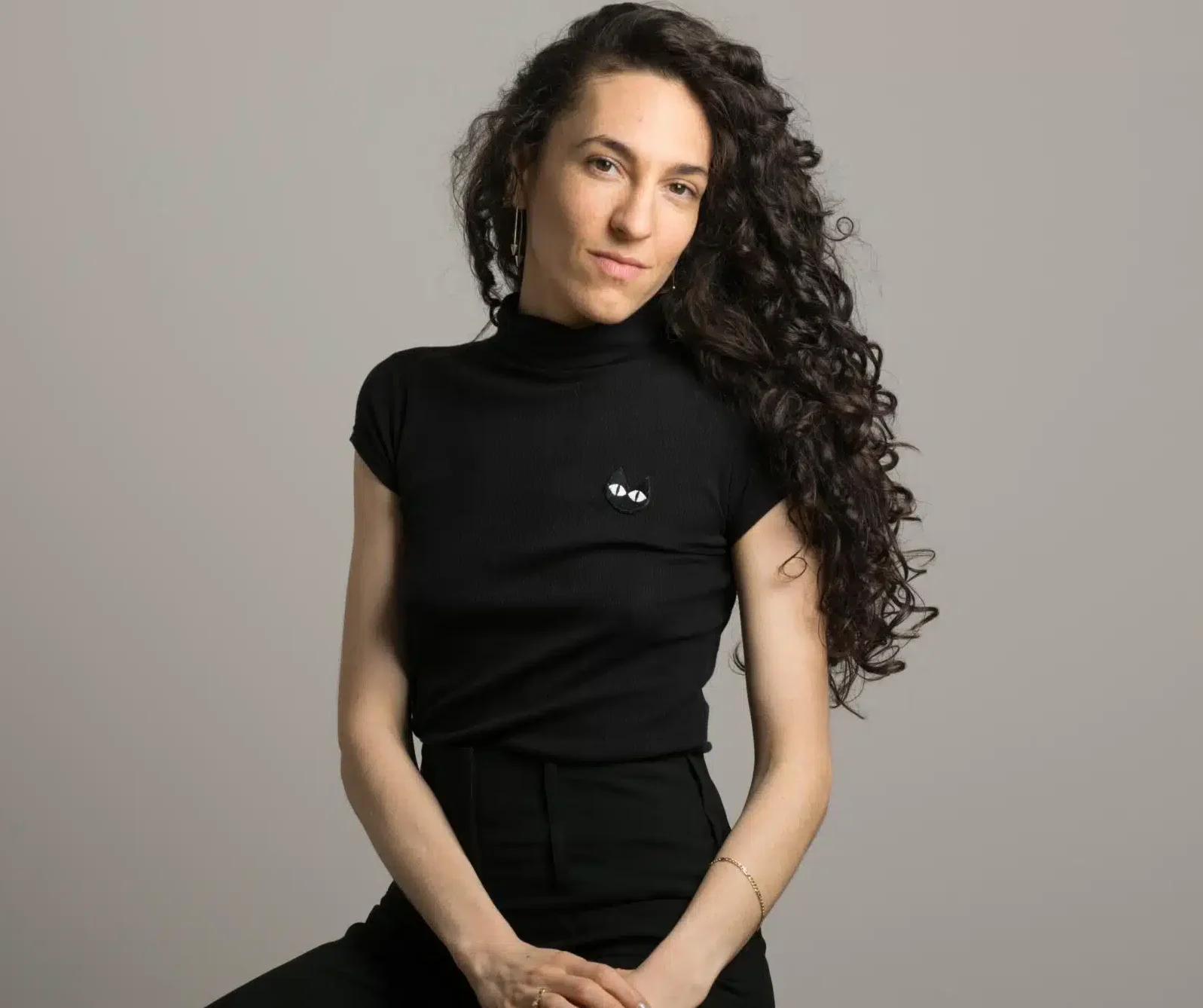
Born Gabriela Najmanovich, also known as “Gaba,” she is Argentine and a strategic trends consultant. I started following her because of an article published in the magazine Aguinaldo, titled En Defensa de lo Grasa (available only in print). I loved that piece. She has a background in journalism and design; she studied at the UBA and also attended the London College of Fashion, and she produces a lot of relevant content for anyone interested in keeping up with consumer behavior trends—which is essentially what her newsletter, which she’s been publishing since 2021, is all about: “Exprimido de tendencias”.
One of the takeaways from my conversation with Ioni Abelson was when he said: “There’s a lot to learn from marketing.”
You’ve worked for consulting firms like Mintel and Kantar and for companies like Adidas, Tulipán, and ELEA. I really appreciate you coming, because there are actually countless topics I’ve jotted down—about ten or fifteen points—but we won’t be able to cover them all. However, I think that someone with this interest in the future and in trends will be able to help us learn a lot—as you would say—to squeeze all the juice we can out of Gaba.
The first thing I want to ask you is: what’s your job like?
I haven’t traveled in a long time. I travel with my senses. I do a lot of desk research, so that takes me through different markets. My work is very diverse—it really is—and when someone asks me, “So, Gaba, what’s your job like?” I have to take a step back and start thinking about, on the one hand, all the things I do and all the different formats I produce.
Basically, what I do is help companies anticipate major shifts in consumer behavior and understand who the consumer is and where they’re headed. How do I do it? By writing reports, conducting trend tours—for people coming from abroad who want to develop products or services for Argentina, targeting a specific demographic or addressing a specific research question—and connecting them with that demographic. I conduct interviews, observe where they spend their time, and do a lot of observation. My work involves a lot of observation and interpretation: seeing what’s happening, connecting the dots, and then saying, “Okay, these dots together mean this, and in the future they’ll manifest in this and this way.”
I also give talks. The other day I met with a colleague, and he asked me under what circumstances people call me. Often they call me because they’re desperate: “We’re doing really badly; I need to understand who my target audience is—the consumer.” And often they also call me to inspire a team or a group of clients, to give them some insight, to add value to the proposal—especially in service companies.
I have a great role. Sometimes I come up against the awful part of my work, which is being very alone, thinking on my own, and writing a lot. And sometimes I say, “Wow, what a great job I have, what a great job I’ve built for myself.” But like everything else, there are two sides to the coin.
I mean, you’re your own boss, and that has its pros and cons.
Exactly. It’s true. The loneliness in this kind of work is pretty intense. You can be your own boss in a very social job, but being your own boss in a research-based, desk-bound job—where you’re reading and writing a lot—can be overwhelming.
And did that lead you to start running?
You know what? I’ve been running since I was really young, since high school. Even back in high school, I’d go for a run to clear my head on a bad day. Running in a group helps me a lot and feeds my addiction. It’s my addiction. I used to smoke, but now I don’t smoke—I run instead.
Are you a digital nomad?
No, not at all. I’m from Buenos Aires. I live with Diamante and Barroco, my two cats, and I wouldn’t let them go for anything in the world. I get anxious if I’m away for three days. I have a cat sitter who sends me videos every day, and a friend who stops by once a week and video calls me so I can see the cats. So I’m definitely not a digital nomad. I’m a huge fan of Buenos Aires and Argentina. I love my homeland dearly.
I love that. I’m going to take this opportunity to ask you about something you wrote regarding “meta-Argentineness.” What is that?
It’s a trend I identified last year. And I’m seeing it become even more pronounced. It’s the new connection Argentines have with their Argentine identity. On the one hand, it’s very meta; on the other, it’s fresh, ironic, and raw. Embracing our history, laughing at ourselves, reviving historical symbols. Despite our recent reality, there’s a resurgence of patriotic sentiment. The folk saint Gauchito Gil —the most important one in Argentina— is making a comeback as a pop icon, appearing in cool settings, far removed from his pagan origins. He is being reinterpreted. There is also nostalgia: the revival of traditional neighborhood restaurants and Argentine pizza.
Limay’s soccer jerseys also embodied this “meta-Argentineness.” Limay is a brand that started out making jeans and now focuses more on clothing in general. They work with cooperatives and offer the full range of sizes. Whenever I can, I talk about Mechi, the brand, and the project, because it shows that you can have a brand that is ethically developed, sustainable, profitable, and growing. To me, it should be a case study in business schools worldwide.

In 2022, Mechi put together a collection of casual soccer jerseys—perfect for everyday wear—drawing inspiration from World Cup fever. Always with gender and sexual dissidence front and center. That was a crystal-clear example of “meta-Argentineness.”
You reminded me of some T-shirts that Unitivo released, which feature bus routes. They’re like soccer jerseys, but for bus routes 39, 10, and a couple more.
That’s awesome—I hadn’t seen them. Is this recent?
About a year ago.
That’s so cool—I haven’t seen them. But I have seen Unitivo—Unitivo is spectacular: they have T-shirts featuring traditional Argentine foods, like pan con manteca, medialuna, and sifón con vino. That’s nostalgia translated into a contemporary language. It’s totally “meta-Argentineness.” It’s very much in vogue in fashion, but we’re also seeing it in other industries: the revival of traditional neighborhood restaurants and Argentine pizza.
In the meantime, I’m going to tell you about a few things that occurred to me as well. Just yesterday, I was editing my own blog, and Ioni had mentioned an article titled “¿Por qué la gente feliz vota a partidos enojados?“ (2019). In it, he mentioned the happiness index for different countries and said that there was no correlation between the governments that were elected and that index. I looked up Argentina’s happiness index, and we’re ranked 12th this year—we’ve moved up four spots. I found that incredible, because if you ask people how we’re doing, they’ll probably tell you “very badly.” And there are reasons to say that. But at the same time, there’s this figure. In contrast, the United States has been losing ground in that ranking in recent years.
Another point you make that interests me a lot is the emergence of a new generation, Generation Alpha. For example, the children of my nieces and nephews were born after 2010 and are part of Generation Alpha.

As someone who studies consumers, could you give a brief overview of the differences between Boomers, Generation X, Millennials, Generation Z, and the Alpha generation?
A lot. Get ready for a master class. Let’s take it step by step.
- Boomers: basically our parents. You tell me yours are 70, so yes, they’re boomers. My mom is too. They have purchasing power that’s incomparable to what we and Gen Z will have. Unlike their parents, they’re in good physical and cognitive shape. They’re financially secure, with plenty of time on their hands and a desire to live the life they didn’t get to experience while they were working. They’re starting to spend, learn new things, and enjoy themselves. They’re a very lucrative market. And we need to dispel the myth that they don’t know anything about technology: they use WhatsApp, Instagram—whatever they need. They don’t need to keep up with ChatGPT like someone in their 30s or 40s, but they adapt. Their core values used to be hard work; now they’re engaging in social gymnastics to adapt to current values like inclusivity.
- Generation X: the bridge between boomers and millennials. The last analog generation. The ’90s.
- Millennials: us. We’ve strongly championed inclusion, diversity, and sustainability. We’ve redefined the concept of family: multispecies families, single-parent families, families with same-sex parents, and throuples. We’ve opened the door to the digital world, even though we aren’t digital natives. Our discourse is deeply rooted in diversity.
- Gen Z: the first digital natives. A childhood spent in front of screens. They are the generation of activism, but with contradictions. They preach sustainability, yet continue to perpetuate a culture of waste. Their consumption habits are less consistent with what they say they value.
- Gen Alpha: the generation of total virtuality. The “iPad kids.” Babies who use tablets as virtual pacifiers. They have unrestricted access to the entire world. This raises challenges regarding how their habits, human connections, and cognition develop. They live in a society that is local in the physical world but global in the virtual one. We adults still don’t know how to regulate that access.

You brought up a topic that interests me beyond just my professional capacity. I don’t think we’re fully aware of it. There’s been a lot of talk lately about phone addiction, but I don’t think the scale of the problem is being adequately recognized. What we’re dealing with is something very powerful, fast-paced, and intense—it’s penetrated our lives and never stops to assess its impact. I wouldn’t rule out the possibility that we could suffer strokes at 45 if we keep this up. Deep down, we’re still animals, and I’m concerned about how this might affect us in the long term, both mentally and physically. You’ve been analyzing this since the pandemic—what changes do you see in these generations, from millennials onward, in terms of how they engage with the world?
Technology makes it harder for us to connect with others in person, face-to-face. But what I’ve seen post-pandemic is a strong desire to step away from the screen. And that translates into consumer trends: a boom in running clubs, mass events, and festivals. Dating apps aren’t working. On social media, you see that joke: “Tinder not working for you? Go to a running club,” and they show young men and women meeting while running.
New trends are also emerging, like daytime raves at coffee shops or bakeries. People are seeking healthier ways to socialize that fit the lifestyles of those in their 30s and 40s. As parenthood is being postponed, couples form later in life, and partying adapts to a different pace. So solutions emerge, like an afternoon rave at a specialty coffee shop. Deep down, all of this boils down to the same thing: we’re spending more and more time staring at screens, and there’s a growing, urgent desire to break free from the screen and connect immediately, in a human way—unmediated by technology or the asynchronous pace of texting.
And how do sports fit into this? I think you mentioned in a newsletter that it’s no longer so focused on performance, that there’s a more amateur-oriented trend on the rise.
Sports are beginning to emerge as a lifestyle and a space for socializing. They’re also part of the creator economy. Sports marketing is booming right now. Amateur sports have always existed, but today they’re being boosted by the wellness culture. It’s a “time out” from technology and a “time in” with the physical world—a return to feeling the body.
The virtual world separates us from our bodies: from touch, taste, and smell. So we seek out stimuli that restore that complete experience. From sports to trends like “crunchiness” on TikTok, or the boom in fragrance among young men. Everything points to a return to the body, to becoming embodied again.
One of the things that interests me is the topic of work among Gen Z. It seems that getting promoted isn’t as important as other things: health, relationships. How do you see it?
There are two concepts that have become trendy: quiet quitting and “emotional salary.” Quiet quitting means disengaging: working just enough, without vocational expectations. It’s not new, but it went viral on TikTok. What changed was the name. “Emotional salary,” on the other hand, refers to the intangible aspects: being recognized, having a diverse team, having your time respected, and feeling valued. It’s not about salary or traditional benefits; it’s the part that enriches life in non-material ways.
What’s the deal with death? Is the way we relate to it changing? Is there a potential business opportunity there?
I find this really interesting—I’m a fan of the topic. Yes, there is a business opportunity surrounding death: composting the body, preserving a person’s memory using artificial intelligence so that grandchildren who never met that person can converse with them. There’s also the figure of the death doula. It’s an emerging field—I don’t know how much it will take hold—but it exists.
At the same time, medicine and technology are advancing toward longevity. Nanobots that clear away cholesterol or eliminate cancer at the single-cell stage. It’s projected that in 20 years there will be far more 100-year-olds than there are today. We’re living longer and better lives, and that brings the idea of immortality closer. Between that and the possibility of talking to the dead via AI, a whole new frontier is opening up. We still don’t know where it will lead.
Nanobots, AI to talk to your deceased partner… very Black Mirror.
Exactly. All of that is already in development. These are open questions that still have no answers.

What books would you recommend to someone who wants to discover the things that inspire you?
“The Signals Are Talking: Why Today’s Fringe Is Tomorrow’s Mainstream” (Public Affairs Books, 2016) by Amy Webb, essential for understanding how today’s fringe is tomorrow’s mainstream.
“On Trend: The Business of Forecasting the Future” (University of Illinois Press, 2019) by Devon Powers, on the business of trends.
“The Tipping Point: How Little Things Can Make a Big Difference“ (Little Brown, 2001) by Malcolm Gladwell, on how trends and messages spread, comparing them to epidemics. It features great case studies: Sesame Street, the independence of the United States, and the reduction in crime in New York City. It’s both entertaining and useful.
Today, with the internet, everything is more accessible. Between translators and ChatGPT, it’s much easier.
Absolutely. It used to be harder; now anyone can access it.
To wrap things up, how did you get into this field?
I studied Fashion Design and hated the program from start to finish. I was never any good at the practical part, though I did very well in the theoretical aspects. That’s when I took my first sociology class and got my first taste of trends: a mindfuck. I thought I’d never be able to work in that field.
Eight or ten years went by. I graduated, studied abroad, and got to know various consulting firms. A second cousin of mine, much older than me, lived in Mexico and then in Brazil. We ran into each other in London while I was there; we had coffee, and she told me she was starting a job at a trend consulting firm. That was it.
I returned to Argentina, and a year and a half later, she told me that her husband was looking for someone to write about millennials in Latin America. I wrote that report—I loved it. Afterward, I scouted yogurt launches, looking for innovations and framing them theoretically. I wrote to my cousin again—the guy covering Chile was just leaving—and that’s how I got started. I haven’t stopped since.


