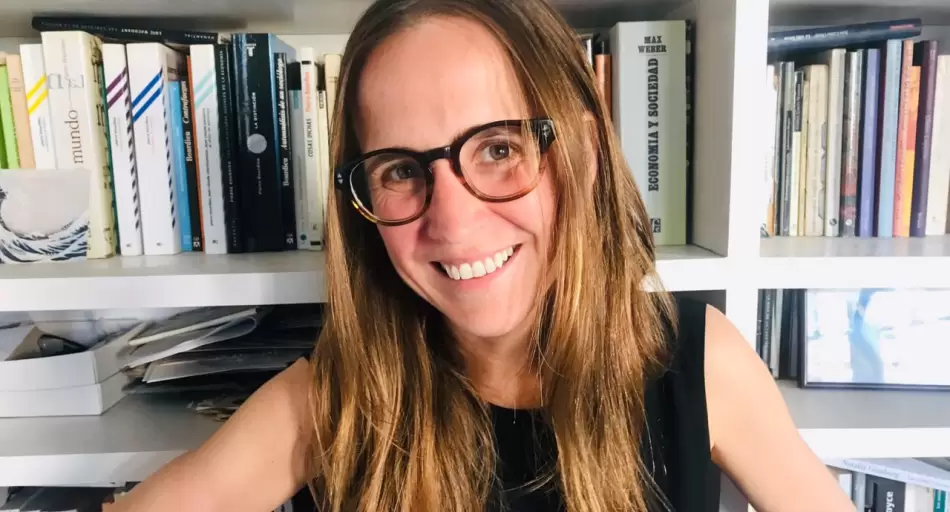
Mariana Gené: “What it takes to be a political operator is one thing; what it takes to be president is another”
By Lucas Malaspina
Mariana Gené is a political sociologist and CONICET researcher who teaches at both undergraduate and graduate levels at the IDAES School of the National University of San Martín (UNSAM). She holds a Ph.D. in Social Sciences from the University of Buenos Aires and a Ph.D. in Political Sociology from the École des Hautes Études en Sciences Sociales in Paris. She also directs the academic journal Papeles de Trabajo.
Her book La rosca política (Siglo XXI, 2019) established her as an essential authority when considering who Argentina’s political operators are and what they do: those behind-the-scenes operators who negotiate votes one-on-one and sustain the day-to-day governance of democracy. In 2023, she co-authored with Gabriel Vommaro El sueño intacto de la centroderecha (Siglo XXI), an analysis of the achievements, failures, and coalitions of the Cambiemos administration.

The conversation took place during the podcast’s final episode of the year. With Milei firmly in power, the PRO in an uncomfortable position, and Argentine politics increasingly shaped by social media, the question of the political operator’s role—and whether that profession is still what it used to be—proved more relevant than ever.
The Book and the Political Moment
In 2019, La rosca política was published. What other works followed?
Later, in 2023, Gabriel Vommaro and I published a book titled El sueño intacto de la centroderecha y sus dilemas después de haber gobernado y fracasado. It’s a book about the Cambiemos administration’s experience—not about its formation, but about its achievements and failures, its coalitions of support and veto, and just how far that project was able to go. We considered how much room there was for a center-right or right-wing project in Argentina. And four years later, obviously, the landscape continued to shift: that political force that seemed poised to make a comeback has been greatly overshadowed by La Libertad Avanza.
The book’s cover said as much, in a way: when Macri lost, they lost—but comparatively speaking, they won.
Exactly. What Gabriel and I were saying is that they came out ahead: they lost, but with a coalition that proved resilient, one that remained united even after the defeat. There were good reasons to stay united: they had garnered more than 40% in the runoff election, the “Sí se puede” marches had given them a more robust identity, and in fact, with the 2023 elections, they were governing more provinces than ever before. The thing is, the upheaval caused by Milei’s arrival—and above all, the dispute over his social base—changed the landscape. Those voters who may have elected PRO or Radical Party governors in the provinces voted for Milei in the national election and want those governors not to throw a wrench in his plans. And Mauricio Macri does not seem to have found a clear position this year, nor have the other PRO leaders. No one seems to have wanted to differentiate themselves too sharply from La Libertad Avanza, at the risk of being absorbed into it in next year’s elections.
The scientific system under pressure
As a CONICET researcher, how did you experience this past year?
I would say that the entire Argentine scientific system was under siege this year: underfunded, under attack—and that affected researchers across all disciplines. There were massive cuts to doctoral fellowships and admissions to the research career track, a slowdown in all processes, and a freeze on funding for team projects. A situation of uncertainty in which a lot of bad news piled up. This is very bad news for Argentina as a whole because the country’s science and technology system is truly outstanding, and it took a great deal of effort to build it.
How do you respond when people say that the social sciences don’t produce anything useful?
Different scientific disciplines contribute in different ways to the creation of knowledge and value. The social sciences diagnose social problems, help us better understand them—and thus enable the development of public policies to solve them—and contribute to a better understanding of Argentina’s recent history and its history in general. At the same time, CONICET is perhaps one of the few government agencies with such a clearly established career track, featuring periodic evaluations and exams for promotion. It’s not a matter of friends getting published—the process is very demanding. To secure an initial fellowship, a postdoctoral fellowship, to enter the career track, or to advance within it, one must take exams, submit reports, and win competitive selection processes. That idea that it would be better not to attack things that work well… In fact, Nature recently issued a warning about the dismantling of science in Argentina, which—if we look at ourselves in the mirror of first-world countries—we should take seriously.
Political Operators: What They Are and Where They Come From
How did you become interested in political operators?
I came across them almost by chance, having initially set out at the beginning of my career to compare the Ministry of Economy and the Ministry of the Interior. A great deal had been written about economic experts in the 1990s, during the structural reforms, but there was almost nothing about the Ministry of the Interior: it was an obscure, little-known place. I began by interviewing former ministers and former officials from the ministry, covering the period from the return to democracy through 2007. And once I delved into it, I became passionate about the subject. Little by little, the contrast with economists mattered less to me than understanding what these architects of political negotiation and democratic governance actually did.
They are essential to small-p politics, not to politics writ large: not for setting the broad direction or inspiring entire generations through great leadership. Nevertheless, political operators are essential to those great leaders. They are the architects of the day-to-day workings of democracy: of that negotiation among actors to ensure that, in addition to having great ideas, there are ways to carry them out.
What do political operators in different countries have in common?
I worked primarily with researchers in France—where I received my training—and in various Latin American countries: Mexico, Ecuador, and Brazil. Those actors, who serve as connectors, share a fairly common set of attributes. One of the main arguments of La rosca is that there is a division of political labor: not all politicians do the same thing, nor can they do the same thing, because they aren’t all equally skilled at the same tasks. There are politicians who are very good at making statements, very good speakers, and very good at mobilizing people; there are others who are expert spokespersons on certain issues; there are others who work on the ground; and there are politicians who are very skilled and astute at understanding the complexity of negotiation among peers. Until now, that negotiation has involved both persuasion and coercion: maneuvering between those two possibilities.
What qualities are valued in a political operator?
When I asked all of them what a good Minister of the Interior must have, the answer was almost without exception: a background in politics. Knowing the political codes, knowing the key players, having a network of contacts, having a phone full of numbers where people actually answer when you call. And having the authority to get them to sit down and negotiate with you. You also have to be trustworthy: keep your word. Know that someone who says yes or no to you can follow through on what they say. They had extensive political careers: they had been active in politics since high school or college and had held many elected and non-elected positions.
Milei’s Government and the New Political Deal-Making
And now, who are the political operators?
Now, all of a sudden, those political operators are Karina Milei, Santiago Caputo, Lule Menem—building the party with Karina throughout the country—and Martín Menem, from the presidency of the Chamber of Deputies. The two Menems have a prominent surname but no conventional political career behind them. Guillermo Francos is perhaps the one with the strongest political background, though without the stature of his predecessors. I would say he has a certain willingness to keep learning, but he is also backed by the considerable power Milei currently wields and by the bewilderment Milei causes among his political counterparts. Many of those counterparts feel a mix of fear and confusion, and so the rules of negotiation have changed.
How do the roles of Santiago Caputo and Guillermo Francos fit together?
That’s a very good question. There’s a lot going on there that we’re not seeing. The very fact that Santiago Caputo works under a service contract and we have never heard his voice—I think he spoke once in a 30-second interview when Milei won the election—gives him an intense aura of mystery, while at the same time we know he wields a great deal of power. There were a few times when he openly overruled Francos: when Francos went to present his report to the Chamber and said he could roll back parts of the public information law, Santiago Caputo publicly contradicted him. That conflict was quickly resolved because the one who calls the shots is neither Caputo nor Francos, but the president and his sister. Second-tier figures also carry weight: Leandro Catalán and others in the Office of the Chief of Cabinet, as well as those closest to the other Caputo, Toto. This style of negotiation, as always, involves tensions among actors vying for a bit more power. And it presents the additional challenge of political negotiation in times of “there is no money”: no more public works and far fewer transfers from the National Treasury. It’s a much more arid negotiation, in which threats carry far more weight than dialogue.
Why do you say that coercion carries more weight than persuasion at this moment?
That dialogue with political actors is running much less smoothly and is much less legitimate; there are no actors pursuing it with conviction. Instead, there is the threat of exposing those who stand in opposition. For Peronism, that’s not a big problem because it’s on the other side. But for the PRO and for a segment of Radicalism, both of which are currently divided, the threat is real: there are voters who defected to La Libertad Avanza and who, in the face of any criticism, any objection, or any attempt to set limits on the president, interpret it as Kirchnerism. So those figures find themselves in a no-man’s-land if they want to oppose him, and also in a no-man’s-land in terms of funding for the provinces they govern. That’s what I mean when I say that coercion carries more weight.
One of my interviewees from the PRO told me that within that party, there are three reasons why different members support Milei: some because they truly believe in his ideas, like Macri himself; others out of opportunism, because they see career opportunities; and still others because they think voters have shifted their support to La Libertad Avanza and fear that those voters will view any criticism with suspicion. The PRO and a portion of Radicalism find themselves in a very uncomfortable position: the opposition space is occupied by others, while they at times occupy the governing camp, but with very little prominence.
Alberto Fernández: From Political Operator to the Presidency
Alberto Fernández appears in your book as a political operator. What went wrong?
When I was doing fieldwork and asking about the interior ministers, I also asked about Aníbal Fernández, and everyone told me the same thing: Aníbal had many of the qualities typical of political operators—a long career, great eloquence, knowledge of the political world, and complete dedication to the cause—but the one who had the president’s trust was Alberto Fernández, who had been with Néstor Kirchner from the very beginning, back when the Calafate Group barely registered in the polls. And that carries a lot of weight: those who were there at the very start of the process.

During his time as chief of cabinet, he filled that role and did so with authority. What I would say is that what it takes to be a political operator is one thing, and what it takes to be a president is another. The Frente de Todos was an experiment: running someone for president who did not have a voter base of their own was unprecedented since the return to democracy. It was a move that seemed masterful in electoral terms—and it paid off at the polls—but when it came to governing, it proved very problematic. It’s as if they now wanted to put Santiago Caputo in as president: perhaps there’s a reason he’s staying in the background; perhaps he’s good for that job but wouldn’t be suited to running for office or governing. That’s the kit of the matter.
Social Media, WhatsApp, and the Future of the Political Operator
How is technology changing this profession? WhatsApp didn’t exist before.
There are technological leaps and changes in devices that also change the nature of negotiations. On the one hand, it streamlines things: you no longer have to hop on a plane to travel to some remote corner of La Pampa to meet with someone. But on the other hand, evidence remains. People send screenshots, forward audio messages—there’s much more room to be caught out. This work of political negotiation takes place, by definition, much more behind the scenes than in the spotlight. And those with a bit more experience know what they can and cannot say in these channels—and to whom. Sometimes they err on the side of being too trusting.
How do you view the entry of new types of figures—influencers, crypto entrepreneurs—into politics?
It concerns me, and I find it very interesting. Politics repeatedly experiences waves of newcomers: in Argentina, we’ve had representatives from social movements, a very large union caucus, and CEOs and managers who entered politics with Cambiemos. Historically, there have always been outsiders. But when they enter the political arena, the political world shapes them: it teaches them that there are rules, that negotiations are necessary, and that there are institutions that, at a certain point, force them to go out and secure votes to pass laws. Many of those influencers or TikTokers who enter politics will, once inside, begin to become politicians themselves, just as Reutemann did in his day.
And it’s also true that the valued asset has changed: before, it was having been president of a university student union; now, it’s having a lot of views and being popular on social media. Some legislators I interviewed for a more ethnographic study in the Chamber of Deputies told me how parliamentary work has also changed: there used to be heated debates on the floor, and now many deputies—from different parties, not just La Libertad Avanza—are more concerned with the one-and-a-half-minute clip they’ll be able to post on Instagram.
What books do you recommend?
I love literature. The last book I read was by Magalí Etchebarne, La vida por delante (Páginas de Espuma, 2024), a beautiful collection of short stories—it won the Ribera del Duero Prize for Short Fiction. And in general: reading Selva Almada, reading Martín Kohan—the range of possible reads is almost endless.
I recently read V13 by Emmanuel Carrère (Anagrama), about the jihadist attacks in Paris and the Bataclan trial. It’s one of those great books you just can’t put down. And La llamada by Leila Guerriero (Anagrama): if you haven’t read it, go read it right away.
As for fellow sociologists, I recommend Una historia de cómo nos endeudamos by Ariel Wilkis (Siglo XXI, 2024). The full title is Una historia de cómo nos endeudamos. Créditos, cuotas, intereses y otros fantasmas de la experiencia argentina. It’s a story of how we got into debt—not just public debt but private debt as well—of the moments when we took on debt, and of how heavily formal and informal debts weigh on families, from the end of the last dictatorship to the present. A great book, very easy to read and very engaging.
And I’m also thinking of De bobo, nada by Pilar Arcidiácono and Luisina Perelmiter (Siglo XXI, 2024). It’s about ANSES in Argentina: it traces the agency’s history, shows a state bureaucracy that works—one that has become increasingly powerful—and highlights the politics of distance and proximity that ANSES pursues, as well as how important it has become for managing social welfare in a society as fragmented as Argentina’s. It’s another great book, too—super engaging and even fun to read, even though it’s about ANSES.


