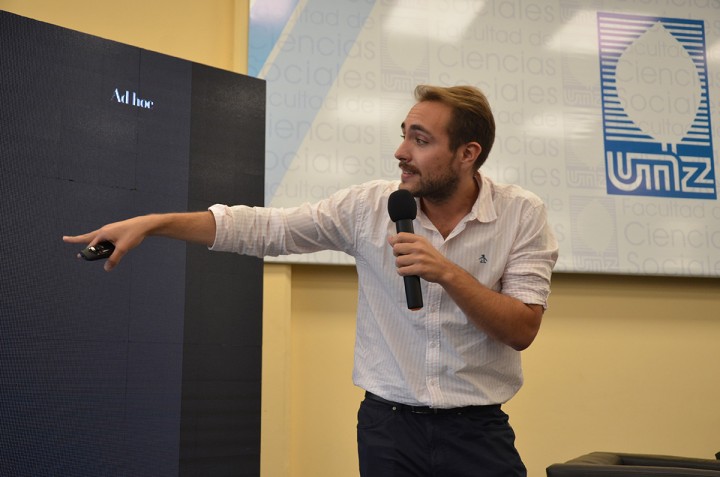
There’s one question Kevin Grunbaum learned to anticipate early in his career: And what use is this to me? More experienced consultants would ask it whenever he presented data to them. They kept asking it. And that question, rather than discouraging him, ended up defining his work: it’s not enough to download thousands of mentions or to have a complete map of the digital ecosystem if you don’t know what strategic decision you’re going to make with that information.
Grunbaum is a political communication strategist, a specialist in social listening, and holds a degree in political science. He is part of the consulting firm Ad Hoc and other projects such as Pulsar. He started out in 2014 as the kid who understood Twitter and, campaign after campaign, developed a way of viewing politics from above: not from the trenches, but from a bird’s-eye view.
We spoke during one of those year-ends that never quite seem to end, with midterm elections just around the corner and Argentine politics reshaping itself in real time.
By Lucas Malaspina
How Digital Communication Entered Politics
When did you realize that digital political communication was here to stay and that this was the path you wanted to take?
Like many things in my life, I’ve always been involved in politics out of personal interest. And I got into the digital world partly because of my generation. In 2014, I started working on an Argentine political website through a friend, and from there I got into social media. I started to see how it all worked and to get involved in politics partly because of my generation: I was the kid who more or less understood how Twitter and Instagram worked. I was literally the social media guy.
As I sometimes say when I teach: we started out as nothing—0.5% of a campaign’s budget. And over time, we grew in importance to the point that today there are campaigns in which 90% of communication—especially in local campaigns—is shaped by social media.
I think it was after 2015 that I realized: this phenomenon is here to stay. Macri understood very well what was coming. I think the door-to-door campaign on Facebook was a milestone in the history of digital political communication in Argentina. The way that action spread and how many residents felt represented by it—that’s when we began to realize there was no turning back.
How have you experienced the changes in politicians’ attitudes toward social media over the past ten years?
Let’s take it step by step. First: those of us who are deeply involved in this tend to think that the entire political establishment has already grasped the dynamics of the new platforms. But Argentine politics still has high-level politicians, decision-makers, and even candidates who belong to earlier generations. There’s still some discomfort with the use of—and the perceived need for—social media, as well as with maintaining one’s own digital presence. In a certain sense, that reluctance isn’t entirely a bad thing, because social media rewards authenticity.

But looking further back, there’s a recurring pattern in every campaign: with each campaign, a new technology or platform emerges; one campaign spots it, and the others rush to copy it. In 2015, we all had to be on Facebook. Then came rudimentary videos in 2017. Then Instagram. In 2019, it was memes and stickers. In 2023, TikTok and videos of politicians speaking directly to camera perform best according to the metrics.
It’s about interpreting that new technology, reading the dynamics, reading the landscape, and having the team to carry it forward. That’s what needs to be done. Politics is still processing all of this, and ten years have passed—which, in historical terms, is a very short time given the sheer number of changes that have taken place.
The Real Impact of Social Media on Society
Beyond politics: How do you view the impact that the spread of social media has had on our daily lives?
I find this much more interesting and profound than the discussion about campaign tools. As early as 2014, during Obama’s second term, it was first reported that Americans were spending more time interacting on social media than in real life: I believe it was 38 minutes versus 37 per day. That was ten years ago. With the pandemic, how much has that percentage grown?
Social media has shaped the way we view the world and the way we relate to others. And these aren’t neutral spaces: they are platforms with owners, governed by a specific algorithm whose goal is to keep you engaged longer and monetize your attention. And they are largely exempt from state oversight. Social media has truly transformed the way we connect with one another and the way we live our daily lives.

The state is linked to the capacity to generate statistics, and in this regard, the major platforms have already surpassed many states. Not only do they have more power: I was just reading Las redes del caos by Max Fisher, which offers an interesting analysis of how Silicon Valley was founded. These companies were founded on a very particular philosophy—one heavily based on merit and on the idea that if you’re of no use, you must be quickly discarded—originally by white, heterosexual men with very specific views on the state. And they carried that philosophy over into their companies. And those are the spaces where we spend most of our time. We can’t do anything about it except navigate that landscape and understand how it works.
The disruptive factor doesn’t have to be the candidate
How does all of this work in a digital campaign? What tools are available to a candidate who isn’t disruptive by nature?
The disruptive element doesn’t necessarily have to be the candidate. It can be the way the candidate frames the key issues of an election.
The job of a digital consultant or strategist is to understand the key themes you’ll use to describe the reality around you, explain it to people, and essentially tell them why you’re going to change it.
Let me give you an example of something we did last year in Mendoza. We had a candidate with a good profile but who didn’t have that disruptive edge; she wasn’t the right fit for that electorate, and forcing it wouldn’t have worked either. We knew the ruling coalition was divided—there were two parties fighting each other after having been allies in previous years. We wanted to explain to the electorate that this fight was a fight between them. So we put two clowns in a garbage dump fighting each other. The video started with the first five seconds showing that; the camera panned, she appeared, and the pace changed completely. She was completely serious, telling you: while the clowns are fighting, we have to do something.
That was disruptive. We managed to break through the media blockade and find a disruptive approach with very few resources. And it wasn’t necessarily the person who was the disruptive element.
Milei is disruptive because that’s who he is; no one can copy that. Massa wasn’t disruptive. But Massa’s campaign was very good in a terrible economic context: with inflation at 200 percent and the dollar at one thousand, he reached the runoff election. You can attract attention in many ways, but it takes time and thought.

What Is Social Listening and What Is It Used For?
For those who aren’t very familiar with it: What exactly is social listening?
It’s a means to an end. A tool that allows us to view the digital ecosystem from a bird’s-eye perspective. For those who’ve played Age of Empires: it’s like activating the cheat code that shows you the entire map. It lets you see the digital ecosystem from above, but always organized around conversations, because that’s how the digital ecosystem works: everything revolves around conversations.
I’m part of the political conversation, the conversation about River, and the conversation about tennis. Social listening lets me see what’s happening in each of those conversations based on specific keywords. What social listening tools do is download large volumes of data—thousands and thousands of mentions. A mention is every time the term I’m searching for appears: if I ask the tool to download everything that says “Lucas Malaspina,” every tweet or article where that name appears is a mention.
What this allows me to do is put things in perspective. It lets me gauge the size of the conversation about Milei or Cristina Kirchner and compare it to others. That’s key because politics has a tendency—one that also affects those of us who work in politics—to see itself as the center of gravity for absolutely everything, when in the digital ecosystem, it truly isn’t.
To give you a sense of scale: the PJ’s internal leadership contest generated 570,000 mentions in one month. Liam Payne’s death generated 270,000 mentions in 3 days. Colapinto’s fall from the balcony generated 140,000. Cristina Kirchner’s bid to lead the PJ generated 100,000. So, is the conversation about Cristina large? Yes. But it all depends on what you compare it with and when.
How does it work in terms of which data can be tracked and which cannot?
What we measure is the public digital conversation—all data that is public. You can’t measure private conversations or locked profiles. Second, you measure the social media platforms you are authorized to monitor. And third, you measure text: a tweet, an article, a mention. What social listening tools pull in is text.
That’s why Twitter is overrepresented in the analyses—because it’s the platform that uses the most text. But in our view, Twitter is also overrepresented in the media ecosystem and the political ecosystem. There’s an overemphasis on what happens on Twitter by the media and by the political sphere itself.
As for major changes: there’s a before and after Cambridge Analytica. Before, you could download everything—Facebook gave you everything via the API. After Cambridge Analytica, all the privacy policies changed, and you could hardly download anything anymore. That left Twitter as a vast island of information. When Elon Musk bought Twitter, that changed again: you can no longer freely download data, and you can only do so if you have a partnership with the platforms. That has greatly limited access to social listening and also makes it clear that the platform owners control the data pipeline they make available to you.
The Milei Administration and Identity Construction on Social Media
The decline in conversation about inflation and the dollar that you mentioned: what explains that?
It’s one of the most interesting findings from what we’ve been tracking since November of last year. The topics that dominated the 2023 campaign were inflation and the dollar; in October, the month of the elections, Insaurralde was the only topic that briefly surpassed them. And since this administration took office, the conversation about inflation has fallen to a surprising extent.
That goes some way toward explaining the present and how the Milei administration uses digital platforms to constantly build identity. The administration is building an identity around its voters through social media, through online discourse, and through the way the “other” is constructed on social media. I find it very funny when Kirchnerists are associated with communists. I know many Kirchnerists, and most of them never in their lives imagined they would be viewed as communists.
Building identity based on the polarization of an “us” and a “them” is nothing new, nor is hyper-segmentation: it used to happen with radio stations. But now we’re seeing actors emerge who use this as a central element to forge identity. And the state is slow to respond, with fewer tools to control what’s happening, while the concept of truth and the scientific method for arriving at an answer are being dismantled. What’s real and what isn’t no longer matters: what matters is who tells you.
And how does that affect the opposition?
There’s something about the dynamics of La Libertad Avanza that’s starting to spread to other sectors. We tracked the exchange between Milei and Cristina on Twitter. Milei is the nerve center of politics: we’re talking about 12 million mentions per month, now down to 7 million. The second most-mentioned figure, Cristina, reaches 700,000. Even at his lowest point, Milei gets ten times as many.
It’s interesting because when Cristina appears, everything else fades into the background. She regains the spotlight and positions herself as Milei’s opponent. But the battle takes place on the playing field where Milei feels comfortable—where he built his identity, where he understands how things work, and even how far he needs to take the debates. Milei retweeted a photo of himself walking mandrills immediately after a spat with Cristina. That says something about how this dynamic works.
A host of traditional players—such as Peronism and the press—who were scandalized by the chaotic logic of the ruling political force ended up embracing that very logic. But that logic is neither comfortable nor familiar to them. Milei is cut out for that kind of discourse; his entire discursive structure is built for it. It’s like Formula 1 materials: they’re super-flexible so they can withstand vibrations. Milei is just like that: he can say he’s going to dollarize, then say he can’t dollarize, and just keep going. Political structures with 30 or 40 years of activism are more rigid and end up breaking.
And that doesn’t just apply to Peronism: the PRO is also caught up in that dynamic. The entire political landscape is trying to figure out which direction to take, because anger and tearing everything down already have an owner in Argentina.
Digital Communities and How to Reach Them
How does politics organize its presence in digital communities?
A friend shared a meme, and someone told him, “Fewer memes and more activism.” It seems to me that there’s something politics needs to start understanding: the digital ecosystem is a space where debates take place. Memes don’t replace activism—we have to keep doing that—but memes have political power when it comes to conveying an ironic message to someone who works eight hours a day in front of a computer and whose only connection to politics is social media. That meme can spark something.
As for communities: we are social beings who need to be with others to survive. The same is true on social media. On social media, we belong to communities with whom we connect, whether or not we are active users. Roughly 90% of people on social media just watch without interacting. Only 1% generates most of the content. The rest listen, watch, sometimes leave a like, sometimes share, sometimes linger a little longer reading a tweet—and in doing so, they feed information to the algorithm.
What those of us who work in politics need to do is understand how to reach these different communities. Reaching a community with a message about an administration’s work is not the same as reaching it with an election message. We need to understand how that community speaks, who its key figures are, and how it presents itself. Some communities are highly caustic and reactive, while others are positive. You have to know which community you’re entering and what you’re going to encounter.
This requires investing in advance. You can’t wait until the election campaign in June and then try to hire social listening services to do strategic work in communities. Campaigns are expensive, and social listening is an expensive tool. It’s an investment you have to make with clear objectives.

What do you recommend we read to better understand all of this?
For me, the bible is Fake news, trolls y otros encantos, by Natalia Aruguete and Ernesto Calvo. It gives a very clear idea of how messages circulate and spread on social media. Las redes del caos, by Max Fisher, is one of the last books I read, and it’s really good. And then, to understand politics a bit better, I recommend Villa, by Luis Gusmán: it tells the story of a government doctor before and during the dictatorship who did what had to be done and ended up becoming an accomplice. I think it explains a bit how the minds of the people around us sometimes work—that not everything is premeditated and that not everything is black and white. And that sometimes politics is defined by much simpler things, like having 200% inflation for a year.
Where can we find you if we want to keep up with you?
On my social media. On Instagram, I’m @kevingrun, and on Twitter/X, I’m @KevinGrun92. And also on the Ad Hoc consulting firm’s social media accounts, where we’re constantly posting analyses and reports.


