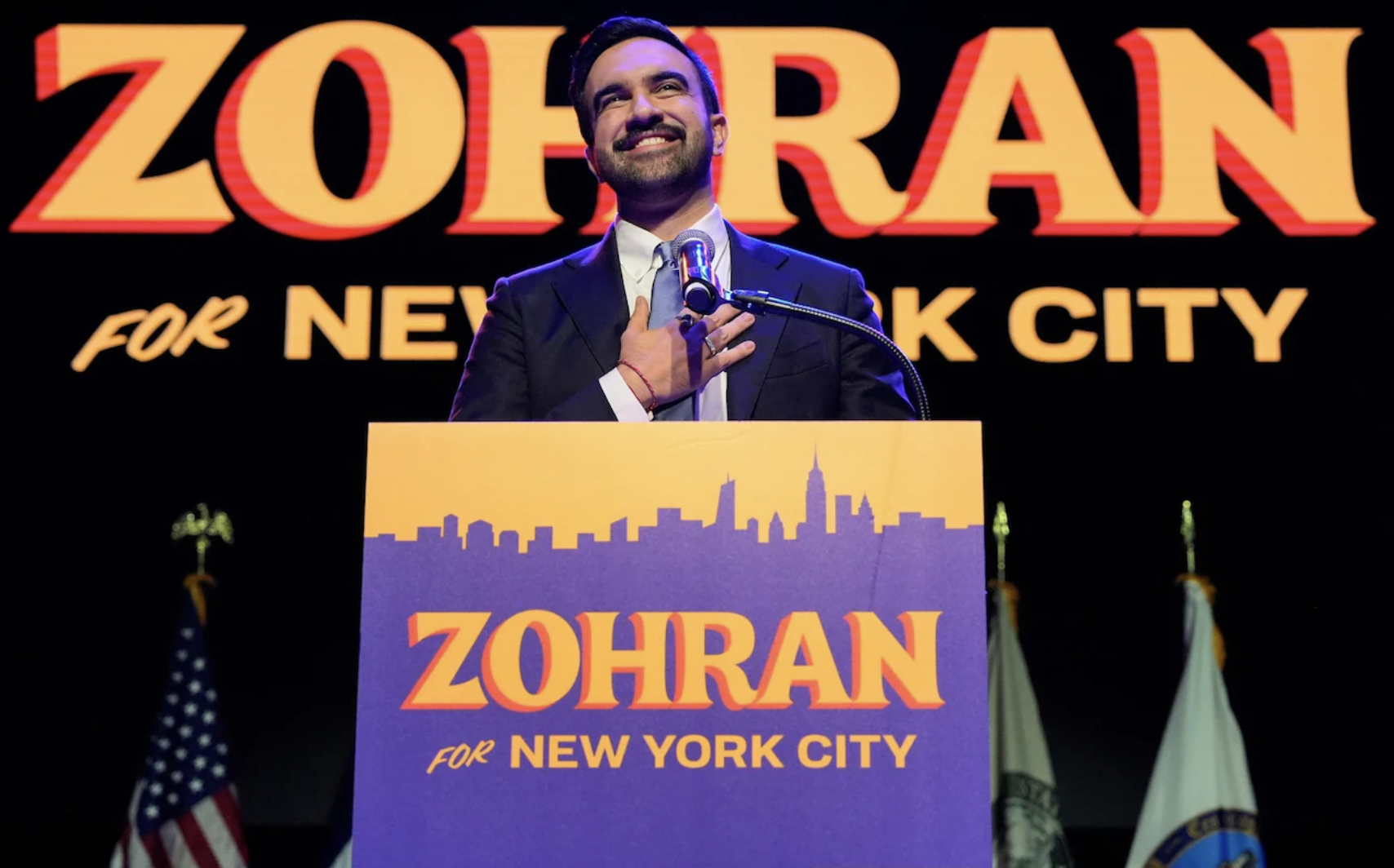
If you work in public or political affairs and your conclusion about Mamdani is “that happens in New York, here it’s different,” you’re misreading it. What is being tested is not (only) an ideology, but a format of power: simple narrative, attention war, technological infrastructure to achieve maximum memorability, agility, and consistency. That is exportable. And someone is going to use it. The only question is whether you will be on the side that learns it or the side that suffers it, regardless of your ideology. If you think you can copy the form without understanding the methodology, you will end up looking ridiculous or irrelevant.
What am I writing about here?
- What a difference the Mamdani phenomenon makes
- The revaluation of communism and the authoritarian past in Gen Z
- The “Casaleggio hypothesis”: can an electoral brand be deliberately incubated in the age of chaos and win elections?
- If Tomás Rebord or Pedro Rosemblat can beat Milei in 2027 (if you are from another Spanish-speaking country, such as Mexico, Spain, or Colombia, I recommend that you pay special attention)
Don’t be confused. The totally unstructured aesthetics and spontaneous vibes of Mamdani’s campaign are one thing, and his true nature, structure, and methodology are quite another. This is how a professional campaign should be, that is, exploiting authenticity in the most methodical and systematic way possible. For Spanish-speaking countries, this may seem conspiratorial (and/or techno-solutionist) because we are not accustomed to “Protestant ethics.” This is a serious mistake. The United States may no longer be the most dazzling power today, but it remains the place where the most advanced strategies and tools for confrontations in a multi-party electoral system are produced. Zohran Mamdani’s victory breaks with the competitive decline in the US Democratic spectrum in the face of the disruption caused by the Trump phenomenon and Make America Great Again (MAGA). Something similar—albeit different in context and role—was already seen mid-year with Gavin Newsom, the Democratic governor of California.
This emergence is taking place within a Democratic structure that is almost constitutionally averse to risk. The party is coming off a decade in which, faced with every disruptive threat, the default response was to “return to the familiar” with a fresh coat of paint: recycled candidates, trusted teams, the same old consultants. The Cuomo case (defeated mayor) is that taken to the extreme: betting on a well-known brand rather than exploring something new that they do not control. That same aversion to risk exists, with its nuances, in Peronism and in European social democratic parties (and is beginning to develop in Morena): they prefer to repeat leaderships and methods that no longer inspire enthusiasm rather than expose themselves to experimenting with different organizational and symbolic formats. Mamdani criticizes precisely this structural preference for the safe option, not just one person or internal current.
There are dozens and dozens of companies involved in U.S. election campaigns to shore up different aspects of the contest: not only do they rely on cutting-edge technology, but they are also R&D units. Some companies are exclusively linked to the Democratic sector, others to the Republican sector, and others to both. They even exist in the campaigns of the Democratic Socialists of America (DSA), which do not reject political methodology and professionalism as “capitalist lies,” but rather, even though they are part of a radical reformist left, they employ these companies and these tools. As we will see, at least that has been largely the case until now.
The story of Zohran Mamdani is already known to all of you reading this.
There is a KEY DIFFERENCE IN THE MESSAGE: Goodbye to “identity politics”? It goes beyond them, but does not abandon them. The “we” is not a sum of labels but a shared experience: tenants, young people, precarious workers. And identities (racial, religious, sexual) come in as different ways of living that same material conflict, not as watertight compartments. “New York you can afford” is a frame of class and material conditions (rent, cost of living, precariousness) that orders everything. It is not “vote for me because I am X identity,” but “vote for me because your daily life is unliveable and this campaign will fight to make it liveable.”
The fact that Mamdani’s campaign was able to establish “a New York you can afford” is not explained solely by the creativity of the slogan, but by the alignment of three structural conditions:
- first, a shared material experience that makes the promise credible;
- second, a biography and positioning that give credibility to the sender;
- third, a dissemination architecture that repeats the same idea at all levels of the system: TV, social media, podcasts, the street, volunteering, and public relations.
The narrative takes hold because it does not compete with hundreds of scattered messages, but rather organizes the entire symbolic and organizational apparatus around a single, simple conflict: who can continue to live in the city and who decided that this no longer matters.
Regarding the main elements to highlight in Mamdani’s campaign, I base myself on what Esteban Concia clearly outlined. It is worth clarifying that isolating all these elements is useless without considering that they are cogs in a strategic-narrative machine.
- Everyday issues (rent, cost of living, transportation)
- Adaptation to formats: TikTok-style vertical video, seeking impact, close-ups, testimonials. But as Iván Sverdlick reminded me, it must be said that they did not deprive themselves of anything: there were also sketches, horizontal spots with the aesthetics of trailers or popular Indian cinema.
- Organization by area of supporters using easily accessible forms and guides.
- A lot of prominence given to other actors and not the candidate.
- Fast pace, large quantity, somewhat sloppy presentation seeking a sense of movement.
These different elements have already been seen in other campaigns, but until now they had not all been exploited together in such a meteoric and exponential way. “A little over a year ago, when he announced his candidacy, Mamdani started with 1% support,” recalled experts Antoni Gutiérrez Rubí and Franz von Bergen (from the Spanish firm Ideograma).
- Mamdani is himself an advanced communication technology: his constant, fresh smile is a political weapon. He was a rapper, his mother is a filmmaker, he is very comfortable in front of the camera in all its formats, and that is not something everyone can do.
- I like to say that it wasn’t all thanks to TikTok (or vertical video). That statement—denial—must be put into perspective because it may involve an underestimation of current social life as it is: producing content in TikTok language (not just format) is absolutely ESSENTIAL in 2025, and we have been saying this since mid-2020 onwards. TikTok is much more than just TikTok.
With his TikTok strategy, Zohran Mamdani achieved memorability: at least being remembered and identified.
TikTok is:
- Nonverbal communication in motion, which is 80% of REAL human communication
- The dominant language of the era that floods other digital platforms and even TV
- The candidate’s letter of introduction in its most entertaining form in an era when the fight for attention is paramount
- A sustained mosaic of pieces throughout an entire campaign (impacts that shape the candidate’s image).
- A huge typology of diverse formats, each of which is scientifically studied by cognitive psychologists from companies with more resources than any state to evaluate which ones generate the most identification, attributes, etc. And those studies feed the professionals who work on these types of campaigns.
- The ecosystem beyond the candidate’s specific account (which may not exist). It’s not just the micro-videos that come out on the candidate’s account, but everything that comes out in their favor from alternate or side (unofficial) accounts.
To work on TikTok, you must use a method based on studying the candidate’s personality and the ecosystem of human relationships that support them. Sometimes the candidate does not post on TikTok, sometimes they do. Mamdani’s campaign produced TikTok, which is the dominant digital platform of our era (because it sets the tone for the others) on an industrial scale and of the highest quality (which does not mean that they look aesthetically perfect, but rather the opposite). As noted by specialist Xavier Peytibi, NY Councilman Chi Ossé, also a member of DSA, was the one who paved the way in this regard. OF COURSE making good videos is key to winning elections and gaining ground, because making good videos for a campaign of this magnitude involves unparalleled complexity, and no matter how much ground you cover, it is impossible to exponentially grow your campaign if you are not seen on screen.
Creativity relied more on organic conversation, like-minded creators, and the candidate’s ability to set the narrative on different social media platforms. This, in turn, led to donations and volunteerism.
Digital advertising was not a relevant issue thanks to the effective use of TikTok (where political ads are not allowed, by the way) and digital public relations.
The paid strategy was very classic: linear TV as the dominant channel. What was new was that organic performance in vertical video allowed the campaign to maintain that TV presence without relying on large investments in digital ads.
- It is often said that Mamdani and his supporters went door to door tirelessly. This is not a slogan: there is hard evidence of the volume of doors knocked on and volunteer shifts. What is surprising is the level of granularity they achieved and their level of professionalism.
- What is not obvious to a well-informed Spanish speaker is that the territorial muscle was “data-driven,” as they say in the tech ecosystem (guided by data): extremely agile, planned, disciplined, and segmented. The territory director referred to the issue in this way in an interview: “You can’t scale overnight. People need to be trained, see what we’re doing, learn how to do it, take on those roles. We need to solve problems. We start with a script. We adjust the script based on feedback.”
- How did they do it? They used “electoral CRM” software: with that base, emails, SMS, reminders, segmentations, and lists for door-to-door canvassing, calls, or events are automated. At the company level, we are talking about CRM (Customer Relationship Management) software, which serves to centralize the actions of sales or customer service agents and unify contact through follow-up tickets. The logic is straightforward: someone sees a video or a post, clicks on “I want to help,” fills out a short form, and their information enters the “electoral CRM.” From there, the system assigns tasks according to neighborhood and availability, sends reminders with dates and times, generates lists for texting and phone banking, records who actually showed up, and recontacts those who did not. This is what allows the operation to scale from hundreds to tens of thousands of volunteers without collapsing.
- Solidarity Tech: what is new is not only the use of a CRM, which has been around for decades, but who controls it and who it works for. It is the same one Catherine Connolly used in her recent victory in the Irish presidential election. Solidarity Tech is not a long-standing vendor of the Democratic Party, but rather a tool created explicitly for union actions in 2024. It is a platform created by a developer based on his experience organizing app drivers in California. It is, in fact, a kind of left-wing tech business faction building technological autonomy from traditional providers associated with the Democratic establishment. While the blue industry sold services to candidates and committees, here a radicalized segment is creating its own data and logistics infrastructure so as not to depend on them.
- The contribution of fundraising architecture in these cases is not usually appreciated (since in Mexico, Spain, Colombia, or Argentina it is not yet customary?). Obama and Sanders were already significant exponents of this culture. Mamdani continues on this point, the tradition of progressive campaigns with a digital anchor. For this, the Democrats use ActBlue, which for Mamdani was the backbone of micro-donations and processing, with buttons and flows visible from the satellite actors supporting Mamdani. There is no conceptual novelty here, but there is operational consistency: low friction, traceability, and muscle for fundraising spikes when a narrative piece went viral.
Key conclusion:
There is NO opposition between the digital and territorial parts of Mamdani’s campaign, but rather a virtuous feedback loop. Now, let’s be clear: a candidate was able to go from 1% to 50% without mainstream media editorial support solely because of social media. To understand this type of feedback, I strongly recommend Xavier Peytibi’s “Connected Campaigns” (2016) and “Election Campaign Manual: How to Impact the Voter” (2025).
Mamdani’s first victory came against the same candidate, Andrew Cuomo, on June 24, in the Democratic primary. Cuomo lost and decided to run as an independent. Cuomo lost again today in the general election, despite having the support of the outgoing mayor of New York and President Trump threatening the city if Mamdani won. Trump literally posted: “If communist candidate Zohran Mamdani wins the New York City mayoral election, it is highly unlikely that I will provide federal funds, other than the minimum required, to my beloved first home” (November 3, on the Trumpist network Truth Social).
Is ‘communism’ resurging in the West?
All this would be just the most efficient progressive campaign of the TikTok era if it weren’t for one detail: Trump supporters portray Mamdani as a “communist.” Mamdani is not a communist, but merely a left-wing social democrat or radical reformist. Beyond that, what is SURPRISING is that some young people are not shying away from that label, but are recycling it. This is where the second level of this phenomenon comes in.
At the beginning of Javier Milei’s administration, in a conversation I participated in with political scientist Julio Burdman and economist Matías Rajnerman at the invitation of historian Agustín Courel, I warned about the possible effects of the new right’s constant appeal to “communism.” Ultimately, in a society driven by rejection and polarization, appealing to a label to designate the enemy means that that label becomes tied to the approval or rejection of the person who uses it. This is what happened with the banners of feminism and sexual diversity raised by Alberto Fernández’s government: once the economy became unbearable for everyday Argentines, those labels became tied, for a significant sector of the population, to a negative perception of the reality they were experiencing.
Donald Trump has already run for president of the United States three times. So far in his second term, his image has deteriorated more than Javier Milei’s in the same amount of time. He is still a hugely disruptive phenomenon, with the ability to set the agenda, but in the times we live in, this is no longer something new.
Surveys conducted in 2025 by Gallup (the legendary company that founded modern electoral research) and the Cato Institute (a prestigious liberal-libertarian center) show a decline in capitalism, the rise of socialism, and, still to a lesser extent, communism itself, in American public opinion.
Possibly, to refer to the Argentine case, Peronism is not dead; it may even increase its relevance if Milei continues to attack it, but more as an ideological reference and not as figures that are already archaic or outdated for the sector of the population that can define an election. If Peronism represents a unifying force for gestures and projects of national autonomy (real or not), then it may still function as an attractive label for part of the young electorate, although no longer under the same faces or the same narratives, and perhaps not even under the same structure. A national study by Isasi/Burdman in July 2024 showed that among 16- to 35-year-olds, 26% identify as Peronist and, according to the authors, the “Peronist brand” was growing in this segment as memories of Kirchnerism and Macrism faded. Paradoxically, this is a sub-35 demographic that combines Peronist identity with Mileist voting. With regard to socialism and communism, we are not aware of any studies on this subject in Argentina, but given Milei’s constant invective against these ideologies, it should come as no surprise that there are attitudes that can be taken into account.
According to Antoni Gutiérrez-Rubi’s latest book, Polarization, Loneliness, and Algorithms (2025), which draws conclusions about Generation Z in a multitude of countries, some young people no longer see the authoritarian past as merely a horror to be avoided, but as a distorted repertoire to which they cling out of a longing for order and as a way of rejecting the present, due to its precariousness and the breakdown of the emotional bond with the future. On the right, this is exemplified by a certain revaluation of Francisco Franco’s dictatorship in Spain or even Nazism in Germany.
The “Casaleggio hypothesis”: can an electoral brand be deliberately incubated in an era of chaos and win elections?
I’ll spare you the mystery. The answer is yes. Gianroberto Casaleggio did it a few years ago with the Five Star Movement, originally embodied by Beppe Grillo. Obviously, this is only possible if a series of conditions are met, which in his case he was able to exploit.
Mamdani is not an ‘Italian algorithm’ like Casaleggio, but his campaign confirms something we saw before with the M5S and others: a governing force can be incubated almost like a digital start-up.
During 2024, almost all of us read or heard about “The Engineers of Chaos,” the book-essay by Italian-Swiss Giuliano da Empoli, also author of the novel “The Kremlin Wizard,” which addresses the relationship between new populisms and spin doctors (strategists behind each disruptive figure).
In the book I mention, da Empoli describes him as follows: “Gianroberto Casaleggio, meticulous, reserved, focused. A fifty-year-old manager, an expert in digital marketing who presented himself as a kind of postmodern John Lennon, with straight hair falling over an austere face and glasses. A perfect synthesis of the hippie aesthetic and geek culture from which Californian cyberculture had emerged. After spending thirty years at Olivetti—for a long time, the leading IT company in Italy—he had just left the group to found his own company, Casaleggio Associati.”
If you control your own platform that brings together data, content, and logistics, you can build a party like a startup. Politics as a product; leadership as a brand; data as fuel. The goal: to convert attention into organization and organization into votes with short cycles and clear metrics. To that end, Casaleggio made an agreement with Beppe Grillo, a comedian who served as a figurehead. The backdrop, in his case, was growing anti-politics. Engaging content; one-click registration; CRM that schedules and reminds; activated volunteering and donations; MVP proposals that are tested and iterated; a network of creators for outreach; territory with scripts and routes; a control panel with KPIs for acquisition, activation, retention, and fundraising. A hyper-leader accelerates decisions and a (relatively) small team operates 24/7.
It should be noted that the US DSA has been developing, orbiting around figures such as Bernie Sanders and Alexandria Ocasio-Cortez, a powerful militant force for 10 years now: it has grown from a few thousand members to around 80,000 affiliates nationwide, of which more than 10,000 are concentrated in the New York region. This confirms that political parties have not disappeared: they mutate, reconfigure themselves, rely on new infrastructures, but organization continues to matter. That militant base was an invaluable asset on which the “Mamdani startup” was built to reach the New York government. However, without everything else, that militancy in this campaign would have been unable to achieve what it did.
Before “exporting the Mamdani model,” it is worth looking at that cold base: tens of thousands of activists deployed in local chapters, a pre-existing door-to-door culture that in this campaign translated into at least 50,000 coordinated volunteers, more than 1,500,000 doors knocked on and 3 million calls made, years of progressive campaigns refining scripts and databases, and a well-established tradition of small donors. It’s not that anyone can turn on a camera, open a CRM, and create a “Mamdani” from scratch. What is exportable are the underlying theses: turning attention into organization, treating the campaign as a machine that integrates narrative, technology, and territory, and building relative autonomy from the establishment of one’s own space.
The Five Star Movement put a prime minister in power for three years in Italy. When we take a historical perspective, it is striking that we are (so) attracted to Libertad Avanza, which, in short, was much less of a laboratory and less professionalized in its development (although sufficiently lucid to sweep away everything that came before). But that’s another story.
Can Tomás Rebord or Pedro Rosemblat defeat Milei in 2027?
In reality, if this model of “political startup” exists, the obvious question is whether something similar could appear in Argentina (or in other countries, whatever the ideological combination may be). This is something that should concern Javier Milei’s government and interest his opponents. Most non-Argentine readers will wonder who Rebord and Rosemblat are and why they should be interested in them. Specifically, several traditional journalists in Argentina have decided to see in them the possibility of “a Milei on the left” or (now) an “Argentine Mamdani.”
We use them as an example to express a theoretical possibility beyond them specifically. It could be a woman or a man, it could be a boomer without social media or a gamer, it could have references to one political tradition, another, or none at all.
They could channel existing militancy or try to create a third force. But above all, they should be bearers of a new symbolic structure with autonomy of movement, as was the case with La Libertad Avanza or the M5S in its Casaleggio stage, or with outsiders such as Rodolfo Hernández in Colombia. But even in those “from scratch” cases, there was always something that came before. For a leader in Mexico, Argentina, Spain, or Colombia, the operational question is not “where is my Mamdani?” but “what population segments + communities + latent brands could I articulate today if I treated my campaign as a political startup and not as the umpteenth repetition of a tired party?”
In this specific case, we are talking about two skilled Argentine Peronist communicators who have become hugely popular in recent years with cultural-political humor, hosting talk shows and taking advantage in various ways of the possibilities offered by the internet (today mainly YouTube). They have different styles, which we could summarize as Rebord being more absurd, provocative, and baroque, while Rosemblat uses political irony to make people laugh and stir up indignation.
In a way, the Republican Party is a structure occupied by Trump, MAGA, and their YouTubers. Rebord and Rosemblat are emerging from the new Argentine digital ecosystem, where libertarians and anti-libertarians battle it out. In the heat of the pandemic, “drivers became streamers, viewers transmuted into assembly members, and audiences evolved into communities.” In a way, Mamdani and DSA have appropriated the Democratic label of NYC to give it a totally different meaning that it could not have obtained on its own.
If in Spain, Mexico, or Colombia, the center-right or center-left parties do not seriously engage in the battle for attention in the digital ecosystem, they will soon lose the ability to speak directly to an entire generation and could in fact cease to be parties capable of governing and become rentable and losing structures. Vox has been continuously imposing its agenda in Spain, the PP is merely repeating itself, and the PSOE is not recovering. In Mexico, Claudia Sheinbaum’s government is strong, but there are signs of cracks in the leadership and how the Trump administration is seeking to pave the way for its defeat and replacement by a disruptive right-wing alternative. Ultimately, everything that happens has political and narrative reasons, but the ability (or inability) to coordinate action in the new ecosystems is a source of political power (or attrition).
Non-Argentine readers can imagine that President Javier Milei is in a moment of political initiative after his victory in the midterm parliamentary elections. And they will also know that, beyond the tensions and disputes between the supporters of former President Cristina Fernández and the governor of the Province of Buenos Aires, Axel Kicillof, neither is showing anything in strategic-narrative terms that could build a new social majority in the face of a possible runoff in 2027. Many Argentines did not vote. What will those Argentines do in 2027? That will be decisive in determining whether Javier Milei can retain power. If Milei is re-elected, it would be an exception at the regional level: remember that of the last 18 elections, only three in Latin America have achieved this.
I don’t know if Rebord or Rosemblat will want to run as potential candidates or if they are electorally viable at the national level. Perhaps they are already too political: I don’t know. These kinds of unknowns are first and foremost beginning to be resolved with the corresponding public opinion polls. What has undoubtedly happened is that Peronism, in the election two weeks ago in Argentina, has wasted an opportunity to present new candidate prototypes. The same is true for those who finance campaigns in old parties and do not seek to develop new candidates (again, whether or not they come from the digital environment).
But could a new candidate emerge and win the presidential election in just over a year?
First of all, it will depend on what/who generates the most rejection. If the economy remains stable and Peronism once again offers something similar to what it did before (Massa, Kicillof, etc.), Milei’s government could be re-elected.
AKP (Turkey), LREM (France), and Servant of the People (Ukraine) are three cases from the last 25 years that I would like to use as examples, in addition, of course, to the so far successful case of La Libertad Avanza. Erdogan was already a figurehead, Macron was a well-known minister, and Zelensky was a TV star. AKP, LREM, and Servant of the People have something else in common:
- They are built as personal or small group vehicles, not as heavy party machines.
- They use relatively small teams and greater technical innovation in taking advantage of communication opportunities.
- They cover the territory with rapid recruitment of “new” candidates, volunteers, and local networks.
It is the political equivalent of a startup that scales quickly on top of an existing infrastructure (media, social networks, pollsters, consultants). Argentina has already set an extreme example: La Libertad Avanza was formed in 2021 and is now in power. One could argue that Milei and the other three examples were already established figures. That is true, but in the New York elections, a candidate who formally launched his campaign a year ago just won. Who is willing to bet that a Mamdani cannot appear? And conversely, who is willing to bet on making him appear?
This shows any actor that the barrier to entry is lower than it seemed ten years ago. The speed of scale of a successful political project today is similar to that of a well-leveraged digital brand. You don’t need a 30-year-old “company.”
In contexts such as today’s world, and more so in Argentina in particular, the time between an emerging phenomenon and a national government can be 18-24 months. This is not science fiction. It already happened to us with Milei, and it could happen again in 2027. Planning without considering this scenario is a luxury that no one can afford. Today, of course, it is not the most likely scenario. For now.
(Thanks to my friend Manuel Bruzzone, a researcher in cognitive psychology, for his reading and comments. The statements are entirely my own.)


